
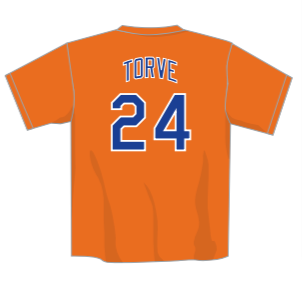
Below is a reprint of an interview with Kelvin Torve I’d done nearly 13 years ago and first published here. In light of the Willie Mays announcement yesterday it’s just as relevant but I want to note here the phrase I used in the headline then, “Accidental 24” I’ve come to believe was more of a clandestine experiment than a goof. I’ll have more to say about the Willie Mays situation soon.
Kelvin Torve was a journeyman ballplayer whose brief career with the Mets is remembered as much for his uniform as for his game. But his moment in history reveals much.
A 10-year minor-league veteran when called up to the Mets to replace an injured Kevin Elster in August of 1990, Torve became the unwitting victim of a procedural screw-up that gave him temporary custody of a uniform number that was supposed to have been kept under guard for one of the team’s immortals. For reasons unexplained to this day they gave him No. 24, a uniform that hadn’t been issued to a player since Willie Mays finished his career with the Mets in 1973.
Joan Payson, the Mets’ original owner and unabashed fan of the Say Hey Kid dating from his career with the New York Giants, had promised Mays the Mets wouldn’t issue No. 24 following his retirement. The succeeding Met ownership, however, never got around to officially retiring the number, leaving 24 in an uncomfortable state of limbo just waiting for a situation like Torve’s to arise. (They should retire it in honor of Mrs. Payson, is what they ought to do). Embarrassed as public outcry grew, the Mets shortly re-fitted the South Dakota native in No. 39.
Torve, who today [as of February 2018] works as a salesman for a packaging company and teaches at youth baseball clinics around his Davidson, N.C., home, for his part remains a good sport about his accidental casting in a freaky Met episode. In the following interview, parts of which were conducted for, and included in, the Mets by the Numbers book, Torve discusses his career including his moment as an overnight sensation in Willie Mays’ clothes.
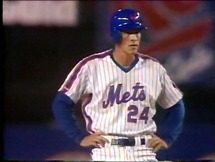 Tell me about your career leading up to the Mets.
I was drafted by the Giants and played four years with them. I was traded to the Orioles and played three years with them, making it all the way to AAA. Signed as a free agent with the Twins and played two years with them, mostly in AAA and part of 1988 with the Twins in Minnesota. After that, I spent two years with the Mets.
When you played, were you mostly an outfielder or a first baseman?
Mostly, I was a first baseman. I dabbled in the outfield, mostly if there was a chance to get another first baseman who hit lefthanded into the game. I also went to Instructional League with the Twins to learn how to catch, but that lasted about six weeks, and I was never to darken the doors of catcherdom again.
I guess that was not all that unusual for a player like yourself who was in the game for a long time and trying to be as useful as you can be.
Right. And I appreciated the Twins for giving me that opportunity. I learned a lot, but it didn’t work out. The ultimate goal would have been for me to be a third catcher with somebody, be a pinch hitter, play outfield and first base and in an absolute emergency go back there and put on the catching gear.
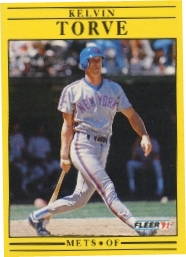 In your minor league career, you were a pretty good hitter [.303/.392/.453 in AAA Tidewater in 1990].
I hit well enough to be employed for 13 years. I was a good AAA hitter and had one good year in the big leagues with the Mets. My bat was what kept me in the game. I had a few opportunities but when you’re a minor leaguer for as long as I was you really have to make a splash immediately if you want to stay. The first year with the Mets, I did, and I got quite a few at-bats. The second year, I think I had only 8 at-bats. I hit the ball hard but didn’t get the breaks. That’s the way it goes.
You were a first baseman who didn’t hit many home runs.
That was the knock on me. I was a first baseman who didn’t hit enough home runs. But the Mets at that time had a guy at first base, Dave Magadan, who didn’t hit many home runs either. They at least had the foresight to challenge that stereotype. In baseball, like in a lot of careers I suppose, if you get a label like that, it’s hard to lose.
I wonder if you can set the scene for me. You’re called to the Mets in 1990 and issued a jersey for the first time. What do you recall about it?
 Nothing out of the ordinary. I just got there and saw a locker with my uni in it, No. 24. I didn’t give a second thought to it. I don’t know who assigned the number, it might have been Charlie Samuels but I’m not sure. I guess they didn’t give much thought either.
They didn’t ask you if you had a preference?
Oh, no.
So you’re in a situation where they take what they give you.
Yes. I had spent a long time in the minors. I was just happy to be there. I would have taken two-point-four if they’d asked me to.
 When do you become aware that there’s some kind of outcry?
When I was called up we had a homestand with the Phillies and I think, the Cubs. Then we went on the road, to California, and while we were out there Charlie came up to me and said, “Listen, we made a mistake with your number. Some people have been calling in and writing in. So we’d like to change your number.”
I just said, “Shoot, that’s fine with me.” I didn’t want to be a pain about it. And I guess they wanted to keep it low-key, not make a big deal about it. So I just started wearing No. 39 from that point on.
Did you have any preference as to what number you would have wanted?
Not really. I’d played so long in legion ball and college and the minor leagues. I think I’d worn every number there was. I didn’t have any preference at all.
Did you hear anything from the fans, or pick up on it, while you were at Shea?
No, I didn’t. That’s not to say they weren’t yelling at me – just that I didn’t hear anything. The first time I was aware of it we were on the road and Charlie came up to me in the locker room and told me that’s Willie Mays’s number, so we have to change it. And I said, that’s fine.
I looked it up, and you were batting better than .500 in the No. 24 jersey.
Hopefully I did OK in it, because I know Willie Mays did it proud as well.
You played briefly with the Mets again in 1991, then to Japan, correct?
 Two years, I played for the Orix Blue Wave. It was a good time. I’m nostalgic when I look back on that time, but while you’re over there it can be frustrating the way they play the game. It’s different than in the United States, and you’re a long way from home. But after leaving Japan, reflecting on it, I realize how much I did enjoy my time there, what it a blessing it was.
I was a teammate of Ichiro over there. When I was there he was a rookie. He was so young he rode his bicycle to the games!
Could you tell at the time he would accomplish as much as he has?
Yes, though back then nobody from Japan was coming to the United States. Watching him play you would say, it’s too bad they don’t because this kid could play in the big leagues. He was 18 at the time and the only thing he couldn’t do well then was throw, and he’s obviously gotten a lot better throwing since then. You could tell he was going to be really good.
What about your time with the Mets do you remember most?
I recall it as a good time because I was in the big leagues. My first at-bat, I got hit by a pitch. My second at-bat, I hit a double that knocked in a few runs [pinch-hitting in a contentious game featuring a Phillies-Mets brawl]. The morning after that I get a call that there’s some policemen waiting to see me in the lobby of the hotel.
Turns out a sports talk radio show had talked about me getting called up, being a kid from the prairie in South Dakota, and being in the big city for the first time. These New York City cops heard that and showed up at my hotel and gave me an escort to the ballpark! They said, we hear you might need help. It was all good natured. I got to be good friends with one of those cops and his family, a guy by the name of Al Weinman. We kept up with Al for years after that.
 My trusty assistant Google then revealed: Frewsberg Native Connor Grey Called Up to the New York Mets, only then I didn’t know where Frewsberg was and had to look THAT up. It’s way out in Western New York; the nearest big city is Erie, Pa.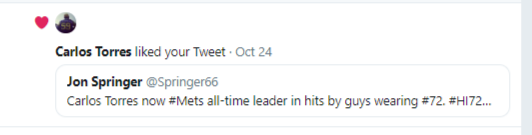
 I’m not going to recap it, just note that Sunday’s win came while we met new Mets: Jose Butto, the rookie who wore No. 70 and looked right away like he was doomed to an embarrassing defeat only wasn’t; and Nate Fisher, a lefty they invented in time to provide three innings of scoreless middle relief to mount the first big comeback. He wore 64.
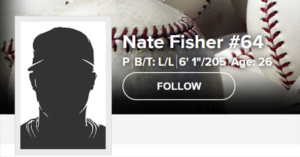 How obscure was Fisher? Now that players and personalities dominate the game, his profile page looks like this.
 Fisher as everyone knows by now was an undrafted prospect who signed with the Mariners, was released when COVID cancelled the 2020 MiLB season, became a banker in Omaha, hooked back up with Seattle in 2021 and was signed as a Minor League free agent with the Mets last offseason. He was primarily a starter at Syracuse and wouldn’t have been an option, presumably, had Steven Nogosek not gone onto the DL after his stint earlier in the Phillies series.
 The first Met in history to wear No. 63 was Chris Schwinden, a righthanded starting pitcher of middling stuff often described nicely as “organizational depth” and not-so-nicely as a “Class AAAA,” synonyms both for a guy who is useful only when the parent club needed an arm in a pinch but was never really considered a part of the long-term plan. Because baseball is unpredictable, and the nature of Met Fandom and Met Ticket Sales are both deeply embedded in the notion of “Ya Gotta Believe” the Mets would rarely describe guys like Schwinden as “not a part of their future,” though, even if its obvious to the team, the fans and even the player.
 As predicted, Yolmer Sanchez was recalled and made his first appearance, and Deven Marrero (15) was designated for assignment. Sanchez appeared in 43 which is unusual for position player (he’s only the sixth all time–Ted Schreiber (1963), Billy Beane (1984 only), John Gibbons (1985 only), Todd Pratt (1997 only) and Shane Spencer (2004) are the only others. This goes without saying but any subset of Mets in which Shane Spencer is the best Met is a world of opportunity, though it doesn’t appear Sanchez is the guy to topple any of Spencer’s 43 all-time offensive records like home runs (4) and RBI (26) despite how modest they are. Who’s the guy with most at-bats as a Met 43 overall? Pitcher Jim McAndrew. Who’s the best 43 of all-time? R.A. Dickey.
 Also outta here via DFA are R.J. Alvarez, who’s already back at AAA Syracuse. Reliever Sam Clay followed Alvarez to “Apparition Met” status, appearing in his first game and wearing No. 46 and subsequently reassigned to AAA Syracuse between games of the doubleheader, making room for Zastryzny in Game 2.
 We’re at a point in the Mets’ season where the injuries have piled up and so have the solutions, and my own failure to keep up has made the Mets roster resemble a junk drawer. You’re looking for something and you find an old watch, coins from a foreign country that you don’t collect, a half-a-dozen half-used Chap Sticks, leftover business cards from a job you no longer have, various pens and pencils, cheap earbud headphones that may or may not work and you definitely don’t want to stick back in your ear to find out.
 Into the ziplock bag have gone designated-for-assignment Mets Travis Blankenhorn (27), R.J. Alvarez (71) , Patrick Mazeika (4), Jake Reed (72), Kramer Robertson (15), Chasen Shreve (43), Travis Jankowski (16), Yennsy Diaz (64), and Nick Plummer (18), making those numbers available.
  I put them in a ziplock because some have already latched back on line in the organization (like Jankowski and maybe Mazeika) so it’s not like their numbers are likely to be reassigned at least right away. Some Chap Sticks however went directly to the trash if they’ve already latched onto another organization (like Jake Reed) or been released (like Yennsy Diaz).
 The used business cards are coaches who are tricky to get into the database due to a design error we haven’t yet fixed between the awesome Ultimate Mets Database, where I record and
  I’m doing all this clearing out in anticipation of meeting Yolmer Sanchez tonight in Philadelphia. Sanchez is a switch-hitting versatile reserve infielder who spent most of his career with the White Sox but whom was just DFA’ed by the Red Sox. He’s expected to joining the club tonight in Philly where another consequential series begins that’s even more important since the Braves gained much of what they lost when a compromised Mets squad lost 3 of 4 this week. That also means that Deven Marrero is about to turn into a Chap Stick, and the 24 hours of fans moaning and groaning on Twitter when they learned he was up and Baty wasn’t was a colossal waste of time and energy because too many people on #MetsTwitter are ignorant and don’t know it, which is one reason I’m cleaning my junk drawer this morning instead of wasting time on Twitter.
 Just a quick update here to tell you something all of us already know: The Brett Baty thing was a thing, and it couldn’t have gone better. He wore No. 22 which I also had associated with him because as noted in the comments below by Gene (and confirmed by Matt), he wore 22 in Binghamton and knew also that finding him assigned 2 in Syracuse seemed unusual to me, but only because I didn’t know how recently he’d been assigned there but it was much less that I thought. I also knew he was considered something like Wright but seemed to have been surprised then to find he batted lefthanded. I can adjust for that a little and say he also resembles a young Robin Ventura.
 In two days, the momentum that seemed unstoppable ground to an abrupt halt, and we’ve been overpowered twice by the Braves who have the opportunity to make back all of what they lost during their humiliating 4-of-5 defeat in New York.
 So I finally learned last night
 It’s not all terrifying though. Anthony DiComo has
  baseman Brett Baty, is reportedly en route to Atlanta. Baty was a No. 1 Mets’ draft pick in 2019 and has been compared to David Wright. He’s killing it wearing No. 2 for Syracuse; on the Mets’ 40-man roster, that number belongs to Baty’s current AAA teammate, Dom Smith, which should be frightening if only for Dom and what remains of his cheering section.
 The best part of any Met game has become what Daniel Vogelbach does with it, now that the outcome has seemingly become less of a point. That’s what 4 of 5 from the Braves followed by 3 easy wins over the Reds has done. Together it’s all part of a 15-4 run since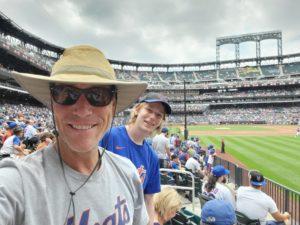
 In Section 105, it’s temporary ignorance of there being two “main” scoreboards and coming very close to a point where the line of vision to the batter is compromised by the equipment securing the foul-ball netting. Other than that it was a few “grown men” in section 106 amusing themselves and no one else by chanting “Let’s Go Brandon” during Nimmo’s turns at-bat, but only a few pitches into it, further demonstrating their ignorance. Nimmo by the way has a new walk-up song, “I Feel Like A Woman” but some country star, I think Shania Twain.
 I shelled out for field level seats, bought the boy a Taijuan Walker shirsey since he’d long grown out of all his previous ones — Wright, Nieuwenhuis and Syndergaard if I recall. The combination of Walker’s turn in the rotation and what he agreed was a cool number, 99, sealed the decision and helped me to suggest his inclination of a Megill 38 shirsey was kind of cool but only if he remembers to wear it again in 10 or 15 years.
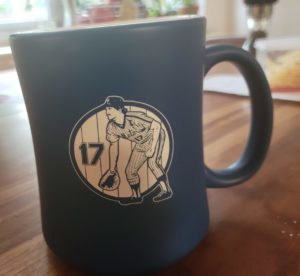 I in the meantime replaced a banged-up Mr. Met mug that has been my No. 1 morning coffee companion ever since receiving it as a David Wright Era father’s day gift. The new one is pictured here.
 That the problem with Drew Smith wasn’t, as I’d suspected, part of the bad luck all around the night Max Scherzer called for the trainer and walked off the mound, when it appeared all Smith could do to resist an inappropriate thing on on a baseball field with 30,000 watching with one of the three Sports Illustrated swimsuit models throwing out a ceremonial first pitch right there between home plate the pitcher’s mound (she seemed to be considering it is all I’d say as a body language interpreter in the Promenade that night). Instead it was some kind of injury, only the kind of injury that makes you give up way too many home runs.
 So that’s also why we have Mychal Givens in the bullpen, along with May, and deGrom is in the rotation but I missed most of the game. Givens is a guy whom I know Buck trusted, so you have to think he asked for it too and though so and I’m beginning to definitely trust in Buck. Like Megill, Givens’ first name seems spelled wrong too.
 Naquin is hitting the crap out of the ball in 25. Givens is No. 60. Darin Ruf (who seems to spell his first AND last names improperly) was assigned 28 and platooning with