Henry Aaron pioneered No. 44 as a number reserved for sluggers, and fellow Hall of Famers Willie McCovey and Reggie Jackson solidified the trend. For the Mets, the 44 jersey has often found its way onto the backs of guys who only think they’re power hitters.
 There was Jay Payton, who had all the muscle of a power hitter but a delicate frame and a line-drive bat. Ryan Thompson could hit it out of the park in interviews but was never as ferocious at game time.Lastings Milledge and his similarly powerful mouth wore out his welcome in less than two years (and only 11 Met home runs).Mike Cameron slammed 30 home runs in 2004 but his hardest hit as a Met was a gruesome collison with teammate Carlos Beltran in 2005.
 What’s a Met 44? It’s Howard Johnson in May of 1991 switching to No. 44 in an attempt to jump-start his game, only to scurry back to his familiar No. 20 in less than a week when his wife reminded him her jewelry all included the No. 20. It was reserve catcher Harry Chiti, acquired from the Cleveland Indians in 1962 for a player to be named later — Harry Chiti, and the Mets would get fleeced. It was four different players as recently as 2008, and I can barely remember any of them: Brady Clark, Tony Armas, Eddie Kunz and Brandon Knight. They threaten to join Kevin Lomon and Tom Filerand Bob Rauch, to name three Met pitchers who wore 44 in my fan lifetime and of whom I retain no specific memory whatsoever.
Like everything in Mets history, 44 was good for a stretch in the mid-1980s — Ron Darling and David Cone each wore it before switching to other unis — but it wasn’t long before 44 was again the domain of guys like Tim Burke and John Cangelosi and Jay Bell, who I still can’t believe chose sticking out to the bitter end of the 2003 campaign over retirement, or the Mets for allowing him .
It’s into this dysfuctional family that Jason Bay officially arrived in a Met press event today. Bonne chance, Jason! Ya gotta believe!

 We recently got an inquiry from a reader who asked about the circumstances around Met coaches
 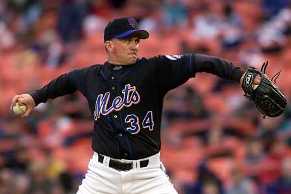 The Mets’ have employed but two pure knuckleballers in their history. The first was righthanded reliever
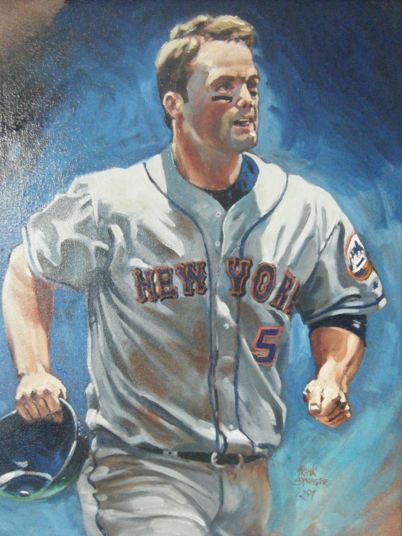 Today would have been my Dad’s 80th birthday. Frank Springer was a freelance cartoonist whose work appeared in comic books and strips, magazines including Playboy, Sports Illustrated for Kids and National Lampoon, and newspapers including the long-defunct Suffolk Sun, which employed him to draw sports cartoons in 1969. After retiring from the commerecial art world in the 1990s he took up oil painting and was doing some terrific work, including the above, until he passed away this April. Born in Queens and raised there and in Lynbook, he grew up a Dodgers fan and then, an original Mets fan. He raised five blue-and-orange kids including at least one obsessive one, and had seven grandchildren who are Met fans too.
 The Mets will become Blanco’s 8th team in 12 years. His numerical history is just as busy, having worn 54 (Dodgers), 35 (Rockies), 12 (Twins), 20 (Braves), 21 (Twins), 9 and 24 (Cubs) and most recently, 28 with the Padres.Given that Blanco looks to inherit
 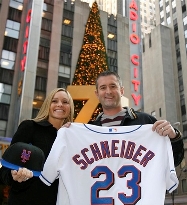 Looks doubtful from here that Coste comes out of his Mets experience with fodder for another inspiring true-life bestseller, but with a decent right-handed bat and some experience playing first base, it’s not out of the realm of possiblity he helps some in 2010. At worst he could be the 2010