
 The rankings below are completely subjective and based upon my own estimation of “Metliness.” Often, Metliness will mean they actually contributed something positive to the team but just as often it probably won’t. These are the guys we associate with the number for whatever reason, and together they reflect the character of the number.Today, as part of MBTN’s 10th Anniversary Spectacular, we honor the Top Ten 10s of All Metdom. Please share your greivances below.
And now, on with the countdown…
10. (tie) Joe DePastino and Joe Hietpas
They’re the Mets’ own version of Joe the Plumbers, only not as stupid … probably. A pair of lunchbucket reserve backstops who each spent only a moment in a Mets uniforms, they represent No. 10’s many brief visitors.
DePastino was a 29-year-old, 11-year minor league veteran who’d stalled at Class AAA when he got the call to the Mets roster in August of 2003 to serve as a replacement for backup catcher Jason Phillips, who’d taken time off to attend to the birth of his son. DePastino’s tenure with the Mets lasted for two pinch-hitting appearances and a single inning of catching, both during the late innings of blowouts (a 10-1 win and an 11-1 loss) exchanged between the Mets and Astros at Minute Maid Park.
‘”If something happens and I never play the game again, I accomplished my goal,” DePastino told the New York Times after the first game, when he grounded out to third batting for Dan Wheeler. “I got to the big leagues. As soon as I came in last night, Piazza said, ‘Hey, you’re in the encyclopedia.’”
If DePastino is a real-life Crash Davis, Hietpas might be a poor man’s Nuke LaLoosh – a minor leaguer whose best quality is a powerful right arm. Drafted by the Mets out of Northwestern University in 2001, Hietpas came through the Mets system and made his big-league debut by catching the final inning of the 2004 season: He replaced Todd Ziele, who caught (and hit a home run) in what would be the final game of his career.
Hietpas never got a turn at bat but that may have been just as well: He was a .208 lifetime hitter in the minors, a guy valued more for his defense than for his stick. Convinced his bat wouldn’t take him any further, the Mets in 2007 refashioned Hietpas as a pitcher, sending him to the Florida State League where he posted a respectable 2.47 ERA out of the bullpen. He struggled last year at Class AA Binghamton, but is signed for 2009 and could resurface depending on the level of bullpen terror in years to come. If so, he’d be the first Met ever to be recalled as a position player and a pitcher. Go Joe!
9. Greg Goossen
“We got a kid here who’s 20 years old and in 10 years he has a good chance to be 30,” Casey Stengel famously said of Greg Goossen. Though by the time Goossen was 30 he was on his way to Hollywood. A catcher/first baseman with fair power, Goossen was drafted from the Dodgers’ system in the first-year player draft of 1964. He spent parts of four seasons with the Mets but by the time they were ready to contend, Goossen vamoosed to Seattle in the expansion draft. His big league career was over at 24: He later gained modest fame as a character actor and frequent stand-in for Gene Hackman.
8. Shingo Takatsu
 Shingo Takatsu made Met history when on Sept. 3, 2005, he trotted out wearing No. 10 – the lowest number a Met pitcher had ever appeared in – and summarily set another new low. Called into protect a two-run lead with two out, the bases loaded and Florida’s Miguel Cabrera at the plate, Takatsu coughed up a ringing three-run double providing the difference in a 5-4 Mets loss that for many, including me, put an end to any fantasies that the ’05 Mets had might challenge for a playoff spot.
Afterward, Willie Randolph memorably defended the decision to call on Takatsu – a fallen star who’d recently been released by the White Sox – by saying he felt the sidearming righty would “bring the funk.” Did he ever.
The loss came smack in the middle of a stretch where the Mets lost 12 of 15 games to fall from a season-high-watermark of 8 games above .500 and four games out of first place Aug. 26 to 5thplace and 12 ½ games back Sept. 15. Takatsu improved some from his debut but it didn’t matter by then. He hasn’t played in a Major League game since.
7. Duffy Dyer
He’s the guy I always associate most with No. 10, since he was the first one I knew. Though his Met career was spent mainly as Jerry Grote’s understudy, Dyer was every bit the hitter his counterpart was, and maybe better – not that Jerry Grote was much of a yardstick for hitters. But still. A big-time jock out of Arizona State, Dyer in 1972 got a Met career-high 325 at-bats while Grote missed significant time with injuries and during the opportunity socked more home runs (8) than Grote ever did in any of his 12 years with the Mets.
In 1973, Dyer’s pinch-hit, run-scoring double in the bottom of the 9th inning was critical in the famous “Ball on the Wall” victory that marked the Mets’ unlikely charge to the pennant. Traded for Gene Clines prior to ’75. Yeah, Gene Clines.
6. Jeff Torborg
Like Art Howe would many years later, Jeff Torborg came to the Mets directly from an American League team; had a reputation for decency and order; and enjoyed the strong support of owner Fred Wilpon. And just like Howe, the hiring turned out to be a bad match, even if the team’s failures under his watch weren’t entirely his fault.
Torborg wound up wearing No. 10 after consulting with a numerologist, which provided a window into his inner goofiness and offered a signal he might not have it as together as we believed. His only full season managing the Mets, 1992, resulted in the so-called “Worst Team Money Could Buy” and he was canned 38 games into the even-worse 1993 season. Technically, Torborg managed 37 games – he managed the 38th knowing it would be his last.
5. Dave Magadan
Dave Magadan was one of the best pure hitters the Mets ever developed but he was curiously underutilized and frequently injured, and never overcame two perceived flaws in his game – a lack of power and a lack of speed. Twice, jobs were taken from him. Twice, a teammate swiped his uniform number.
Magadan wore No. 10 for the 1990 and 1991 seasons only. He debuted in 29 – as the hero of the Mets’ division-clinch victory in 1986 – but ceded that jersey to Frank Viola in 1990. In 1992, he went back to 29 when new manager Jeff Torborg, with the help of a numerologist, selected 10 (see above).
Magadan’s first season in 10 may have been the best of his 14-year career. Despite the indignity of having lost a chance to start at first base by pointlessly imported veteran Mike Marshall (wtf?), Magadan finished the year with a .328 batting average and a .417 on-base percentage – second in the league – while appearing in a career-high 144 games. He slumped some in 1991, and the Mets subsequently imported Eddie Murray (and Bill Pecota, for god’s sakes) to take over his role.
4. Rey Ordoñez
 Rey Ordoñez came along at precisely the wrong moment for an all-glove, no-hit shortstop. Stars like Nomar Garciaparra and Alex Rodriguez were redefining expectations at the position, and statistical measures revealing just how poorly Ordoñez compared to them were becoming the language of the common fan. But his fielding was eye-popping enough to inspire the old romantics, and Ordonez subsequently became one of the Mets’ most fiercely debated players of all time.
Ordonez broke in with the Mets wearing number zero, and, in retrospect, his switch to number 10 in 1998 signaled the beginnings of a slow decline in overall pizzazz. Nevertheless the Mets signed him to a four-year contract after a 60-RBI season in 1999.
Later it was revealed that Ordonez was older by more than two years than the Mets had initially believed. Suddenly on the wrong side of 30, it was less of a surprise when his once-legendary fielding skills fell into decline, and when he uttered a few unkind words about the fans – even if he was right – any lingering arguments over the value of offense vs. defense turned to a near unanimous call for his removal, which the Mets were only too eager to answer.
3. Endy Chavez
 Endy Chavez brought energy, spirit and maybe a touch of Mookie-like magic to the 2006 Mets. His magnificent catch in Game 6 of the 2006 NLCS – which not only stole a home run but turned into a humiliating double-play that should have (but unbelievably, didn’t) inspire the Mets to a league championship – belongs on the short list of baseball’s all-time postseason moments and assured Chavez would never have to buy a drink in New York for as long as he lives.
Throw in a .307 batting average and a few more home runs more than anyone had a right to expect, and Endy’s ’06 goes down among the best ever by a Mets’ reserve. But injuries interrupted a repeat performance in 2007 and while his glove remained magnificent his bat wasn’t the same in 2008. Magic – and productive reserves – only last for so long. His next stop is Seattle. Seeya, N.D.
2. Rusty Staub
Rusty Staub wore No. 10 in Houston and in Montreal but patiently waited three seasons until Duffy Dyer was traded to take the jersey with the Mets.
Staub’s move into No. 10, in 1975, coincided with his best single season as a Met. He hit 19 home runs, 30 doubles, had a .382 on-base average and drove in 105 runs – the latter a team record that lasted until Howard Johnson broke it in 1991. Fearful of players gaining 5-and-10 rights in a new era of worker activism, the Mets traded Staub to Detroit following that season (for Mickey Lolich in one of the biggest trades, pound-for-pound, they ever made) only to watch him rake for another five years. They reacquired Staub again in 1981 when he began a second career as an elderly – though still dangerous – pinch-hitter. He’d last until 1985, at age 41.
1. Rod Kanehl
 “Do you know that the very first banner the fans hung up in the Polo Grounds had my name on it? We hadn’t played a game there yet, but there it was. It said: ‘We love the Mets.’ And under that, ‘Rod Kanehl.’ You know why they had my name up there? Because I was a hero…”
Like most of the nascent Mets, the man known as “Hot Rod” was valued not for his ability but for his determination in spite of it. And in the early days of the Mets you couldn’t get much more for much less than Rod Kanehl, a career minor leaguer who played every position except pitcher and catcher in a three-year span as Casey Stengel’s favorite reserve.
As the story goes, Stengel recalled Kanehl for having leapt over a fence to make a catch while in a spring practice with the Yankees, in whose minor-league system Kanehl had spent most of his career before the Mets came calling in 1962. Kanehl rewarded Stengel’s faith by becoming the first Met to hit a grand slam and scored the winning run in their first-ever home victory. If not fluid in Stengelese himself, Kanehl was said to understand the language of his skipper and translate it for teammates. When Stengel passed away in 1975, Kanehl was the only of the early Mets to attend the funeral.
Kanehl’s grit, hustle and versatility helped obscure meager statistical output — a .241 batting average and just 32 extra-base hits in nearly 800 at-bats over three seasons. But Hot Rod was released prior to the 1965 season, and was heartbroken to see another man wear his jersey (it was rookie Kevin Collins).
“I know the game from underneath. I know what goes on in the mind of a mediocre ballplayer. I know what it’s like to be a bad hitter. I know what it’s like to have to battle every time you go up to the plate,” he told Sports Illustrated in a brilliant 1966 article (also the source of the above quote). “I think the Mets were stupid for not keeping me. And you know what hurt most? They gave away my uniform number even before spring training started. They couldn’t wait.”
 Yes, so happy birthday to Mets by the Numbers. It officially turned 10 last Sunday but wanted to kick things off once I had this alternacommemerative logo, thanks to
 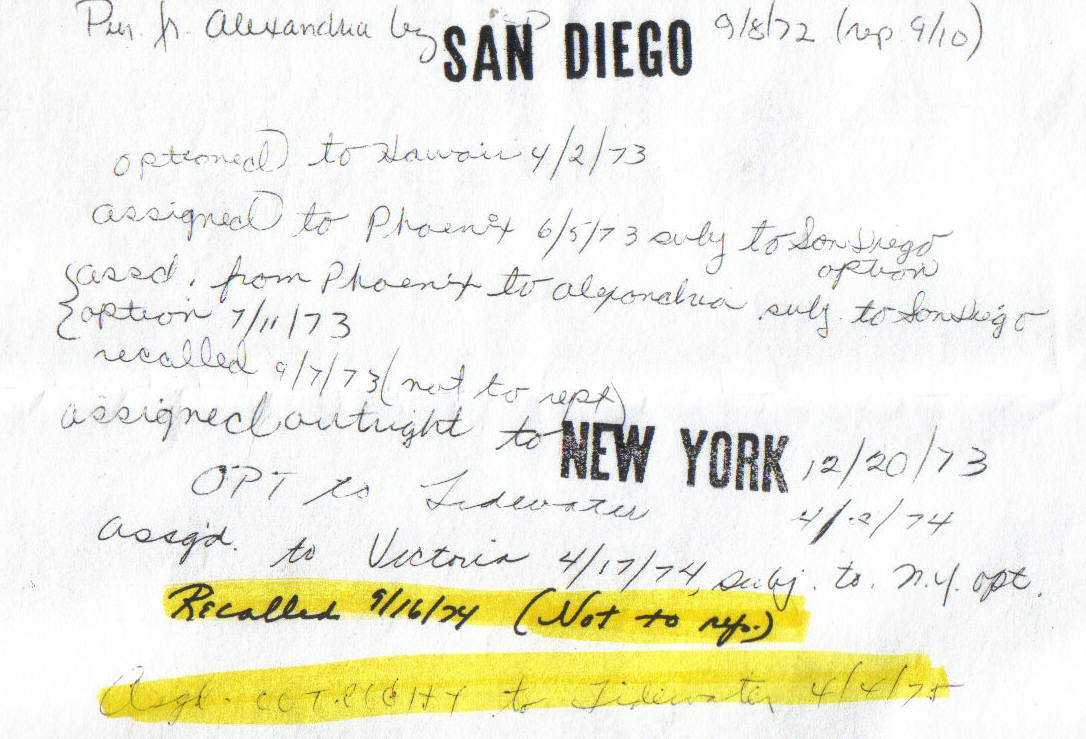 You guys are great. Only hours after the below inquiry on Steve Simpson, the pitcher received from San Diego in the 1973
 For Niemann, 55 marks his sixth different Met uni number: He wore Nos.
 The Mets you have may have seen have inked gangly pitcher Freddy Garcia and outfielder/utilityman Rob Mackowiak to minor league deals and invited them both to spring training. The oft-injured and well-traveled Garcia has worn 34 everywhere he’s played: It will be interesting to see whether Mike Pelfrey has any attachment to it in the event Garcia makes the club. Macklowiak, who seems a threat to Marlon Anderson (lefty, multipurpose player, with a weak bat) will take what he’s given. He’s worn 59 in Pittsburgh, 10 with the White Sox and 12 with Washington.