Is 17 Retired or Just Taking a Break?

17Oftentimes, organizations are best off sticking to their convictions and not giving in to the will of fans, especially when it comes to sensitive stuff like retiring numbers. For the Mets this is an especially vexing dilemma, given that they have so few convictions not to mention so few candidates for number retirement. Fans with opinions, though — they got plenty of those.

I’ve been on record before defending the team’s stinginess when it comes to uni-number retirement. That the Mets are “disrespecting” those players whose numbers aren’t yet retired, or that they lag other teams when it comes to numbers hanging on the walls, are both lousy arguments for taking a jersey out of circulation when the most satisfying remedy lies in the ability to selectively re-issue numbers so as to perpetuate being part of something special. That is, if the Mets were to give No. 17 only to intense, mustachioed, good fielding first basemen; or No. 8 only to charismatic catchers with a flair for the dramatic,  there’d be little argument to the notion that Keith Hernandez and Gary Carter are being dissed or forgotten — and maybe there’d be some pressure on the Mets to actually go out and develop one of them now and again.

All that said, the organization may have turned a corner last year when it comes to No. 17. Perhaps giving into fan indignation and recognizing Hernandez’s growing legend for his post-career contributions to the cause of Met-ness, No. 17 was unissued in 2011. It was the first time in 21 years no Met had worn 17.

Ironically the streak that saw 15 different men wear No. 17 over those 21 years — a streak that for many came to symbolize just  how ignorant the team could be about these things — began with of all things a tribute to Keith Hernandez: David Cone’s switch from No. 44 early in the 1991 season.

From Cone, who wore 17 until his 1992 trade; 17 went to MBTN hero Jeff McKnight, then onto Bret Saberhagen (1994-95), Brett Mayne (1996) and Luis Lopez (1997-99). This century, 17 has gone almost entirely to bums and scrubeenies who spent a season or less in Met-ville : Mike Bordick (2000); Kevin Appier (2001); Satoru Komiyama (2002); Graeme Lloyd and Jason Anderson (2003); Wilson Delgado (2004); Dae-Sung Koo (2005); Jose Lima (2006); David Newhan (2007) and finally, Fernando Tatis, who on July 4, 2010, in the seventh inning of what was to be a 9-5 Mets win, entered the game as a pinch hitter for Chris Carter — Carter was initally called in to pinch hit for the pitcher before Washington provoked Jerry Manuel by bringing in lefty Sean Burnett — and singled. Following the game the Mets placed Tatis on the 15-day disabled list with a right shoulder sprain from which he never returned.

That was the last time a 17 appeared for the Mets. Is it permanent? Or just taking a well-deserved break?

Take a Number

12With the addition of new reserve shortstop Ronny Cedeno and returning pinch-hitter Scott Hairston — and the subtraction of bungled phenom Fernando Martinez, who will try again with the Astros — the Mets say their 40-man roster is whole again and, they say, unlilkely to undergo any further changes before it all begins again.

It’s not just the weather making it as though like winter never came. The additions to the team were underwhelming enough and the finances bad enough that nobody bothered having a press event beyond conference calls or a caravan which is all well and good but denied us the introduction of new uni numbers until, I suppose, pitchers and catchers report. Following are guys on the 40 who are awaiting a number assignment:

PITCHERS: Robert Carson, Juerys Familia, Frank Francisco, Jeremy Heffner, Ramon Ramirez, Jon Rauch

INFIELDERS: Ronny Cedeno, Wilmer Flores, Reese Havens

OUTFIELDERS: Juan Lagares, Kirk Nieuwenhuis, Cesar Puello, Andres Torres

Including the four non-roster invitees who already have number assignments (Miguel Batista, Daniel Hererra, Valentino Pascucci, Mike Baxter) the following numbers (up to 50) are available to issue: 1, 4, 6, 7, 8, 9, 16, 17, 18, 20, 22, 24, 25, 26, 31, 33, 38, 45, 48, 50.

That’s 13 guys and 20 numbers if I counted right. If I include additional non-roster invitees (likely to be issued numbers in the 60s or above anyway) it’s 21 guys and 20 numbers. Who will wind up in which?

Santana’s Backup Band

MBTN reader Zach this week sent along the accompanying image of lefty Bob Ojeda warming up in St. Petersburg. They were culled from footage of “A Season to Remember” the 1986 Mets highlight video that I still have on VHS but haven’t watched since having decommissioned my VHS player years ago. Zach pointed out that some angel recently digitized it and that it now resides on YouTube, at least until MLB’s goons get ahold of it.

As you can see in the stills, Ojeda in these shots was wearing No. 43, and not the No. 19 he would wear when the Mets broke camp. The story behind that relates to the Mets’ decision to demote Ron Gardenhire to Tidewater as insurance for starting shortstop Rafael Santana, rather than carry him on the everyday roster — which at the time required the team to carry just 24 players and not 25. (Were that still the case, we wouldn’t now be sweating Ronny Cedeno). Gardenhire, who’d occupied No. 19 for four years but was a regular only in 1982, got the backup nod over another shortstop candidate, Argenis (Angel) Salazar, who was traded to Kansas City the same spring. Salazar had come to the Mets’ system a year earlier in exchange for Jose Oquendo but like Gardenhire in ’86, would be stashed for the season at AAA Tidewater as a backup for Santana.

Gardenhire’s departure — he was demoted just days before the season began and would not return to the Majors until beginning his coaching and managerial tenure with the Twins — gave Ojeda the chance to wear the No. 19 he’d rocked previously in Boston. No. 43 would next alight on the back of John Mitchell that September.

Thanks Zach for the photos and link! Also, be sure to see Matt’s comment below about Gardenhire bequeathing the 19 jersey to Ojeda and making plans for an eventual return. Great stuff!

Looking Back, Looking Ahead

My friend Greg Spira passed away last week, the end result of a long and recurring battle with kidney disease. Greg was 44 years old, a Mets fan who grew up in Whitestone, Queens, and an editor who among other accomplishments was kind enough to solicit and encourage my contributions to the Maple Street Mets Annual over the past few years. I knew Greg only for a short time, and were he anyone else, he’d probably be one of those quasi-business acquaintences with whom you interact with from time to time but never get to know well. But Greg’s extraordinary intellect, curiousity and friendliness won me over. He was genuinely interested in so many things, a simple phone call to relay a message over a particular point in an article would inevitably become a hour-long phone conversation over a hundred more topics, and an assignment that could easily be relayed with an email would instead become a long lunch, or minitaure golf outing, or a Mets game. I liked Greg a lot. Our mutual friend Matthew Silverman knew Greg very well, and wrote a terrific rememberance of him at his website.

What a trial 2011 was for us Mets fans. In May, author Dana Brand died suddenly at age 56. Dana was in the process of organizing a scholarly conference all about the Mets to mark the occasion of the team’s 50th anniversary. How awesome was that? The great news is that event will happen in Dana’s honor April 26-28 at Hofstra University, and is open for presentation submissions through Jan. 10.

By the time Dana passed, my sister Jennifer was in the final weeks of her life. As I mentioned here before, but haven’t written about much lately, Jen had ALS, or Lou Gehrig’s Disease: a progressive neurological disorder that despite our efforts remains undefeated. Jen’s loss at age 46 deprived her husband a great wife, her three kids of a great mother, my family of a great sister, aunt and daughter, and the Mets of another great fan. Jen was among MBTN’s biggest supporters and totally got the concept. She made sure each of her friends bought one of my books whether they wanted one or not, and she had a lot of friends. It’s impossible to say how much I miss her.

They say a year like 2011 is the kind of thing that puts Mike Pelfrey’s struggles into perspective, and I suppose it does, though the overriding vibe is an urge to see better days ahead. I’d like to think that all three of Greg, Jen and Dana would see this coming season not exclusively as a disaster in the making, but would appreciate it also for whatever it brings, for its particular moment in time. We only have so many of them.

So This is Christmas

There’s been more notable departures than arrivals at LaGuardia this offseason. A look at the Mets roster reveals plenty of empty spaces where the numbers belong, a theme that is likely to be repeated with regards to seats at CitiField while the Mets flounder under an ownership group that at this point has surpassed the DeRoulets for historical incompetance. As I’ve said for some time, the Mets certainly look like an organization headed for (and deserving of) a punishing stay in Chapter 11. Until it gets there, it’s up to the beleaguered, lender-appointed general manager Sandy Alderson to preserve whatever dignity the team can maintain amid the non-offers, layoffs, minor-league shut-downs and salary-dumping trade rumors you can’t necessarily dismiss.

That they’ve added a bunch of players without assigning any of them a uniform number yet is a small indication of where they are. In some ways, they remind me of the Bad News Bears, where Buttermaker is late with the uniforms because he can’t find a sponsor. So on this Christmas Eve, here’s wishing the 12 players and four coaches newly added to the organization and/or its 40-man roster receive numbers in their stockings.

To Jose Reyes, Carlos Beltran, Ryota Igarashi, Ronny Paulino, Nick Evans, Chris Capuano, Jason Pridie, Dale Thayer, Pat Misch: Good luck and success (but not too much success) in 2012.

To Mookie Wilson, Chip Hale, Ken Oberkfell, Jon Debus: Thanks for trying.

To Tom Goodwin, Tim Teufel, Bob Geren, Ricky Bones: Good luck and numbers in the 50s.

To David Wright, Jason Bay: Pokes at a reasonable fence.

To R.A. Dickey: A best-seller.

To Pedro Beato, Lucas Duda, Josh Stinson, Dillon Gee, et al: No sophomore slumps.

To my friends here at MBTN and in the Mets’ fan community: Thanks for reading and a happy holidays!

They Cut Our Legs Out

7Let there be no doubt this is a low moment in the history of a franchise with plenty of them to choose from, but you could see it coming. Because the Mets owners are morons who for way too long invested poorly on behalf of themselves and their fans, they can no longer afford to keep one of the best players they’d ever developed. I always thought the best chance of saving Jose Reyes from signing with another franchise was if a new owner pulled a hero act but the Wilpons couldn’t even get that right and so that’s where we are. Reyes leaves town as the best shortstop the franchise ever had, its most exciting player, and among its most accomplished overall. One can certainly make an argument that he won’t be worth what the Marlins are giving him but that’s beside the point when a formal offer was never presented because it was so unaffordable. Congratulations, Mets.

All that said, I’m anxious as always to move on and Sandy Alderson yesterday began the process. He traded Angel Pagan to the Giants for an older counterpart, Andres Torres, and a nice looking reliever, Ramon Ramirez. Torres like Pagan had a good season in 2010 but struggled this year, and was well-liked by fans and teammates in San Francisco. He wore No. 56 most recently with the Giants, reminding me of another veteran center fielder acquired as a short term leadoff man,Brian McRae. Ramirez, well-traveled himself, wore 52 in Frisco last season.

He’ll be joining a Mets bullpen that will also include new relievers Jon Rauch and Frank Francisco, both signed as free agents. Rauch is a shaggy giant whom Keith Hernandez once called a ‘Wookie.’ He’s hung around for years now despite only average results. Francisco has worn No. 50 his entire career: Word was the Mets would “retire” that number for 2012’s 50th anniversary, so we’ll see what comes of that. Rauch wore 51 early in his career and 60 more recently with the Diamondbacks and Twins.

Goodbye, Nicky Six

Goodbye and good luck to Nick Evans, the blinking reserve infielder whose eight different trips in and out of the No. 6 jersey over the last four seasons embodied its heritage as the most frequently issued number in team history. Evans was up and down so many times his number was issued to not one, not two but three different players who served entirely within his tenure: Abraham Nunez, Trot Nixon and Ramon Martinez. I have trouble believeing any of them were ever Mets.

Evans, who was released by the Mets for the millionth time following the season, accepted free agency at last and promptly signed a minor-league deal with the Pirates for whom he stands at least a slim chance of going all Heath Bell on us. I’ll remember a smashing Saturday debut in Colorado that might have saved Willie Randolph’s job for a few weeks at least but few other highlights until a modest garbage-time showing this year. His absense leaves a void in the No. 6 heritage that surely will be filled by a scrub we haven’t met yet.

6If No. 6 has a counterpart on the pitching side, No. 38 would be a contender. It last belonged to lefty Chris Capuano who parlayed his irritating mediocrity in Metville into a 2-year deal with the Dodgers. I never much understood the regard for Capuano whose 5th-inning crooked numbers arrived like clockwork and guaranteed the bullpen took a beating every night he worked, and, we were reminded, he never missed a start.

That kind of reliability, hopefully with a little more success, will have to be bought anew, perhaps at the Winter Meetings beginning this weekend in Dallas.

Finally you may have seen Bobby Valentine trying on the No. 25 jersey as the new manager of the Red Sox. It’s great to see him back.

Solid Gold

As a longtime critic of the Mets’ questionable senses of fashion and self-awareness I feel obligated to tip my (blue-and-orange only) cap to what appears so far to be a thoughtful and tasteful approach to the team’s 50th anniversary as revealed yesterday. Uni fans know the info by now I’m sure, but they’re dropping the black drop shadows and black hats for 2012 (hopefully the butt-ugly two-toned batting helmets go along with them, as I’ve long felt nothing looks any worse). They said they’d use the black alternate jerseys for selected away games only; and introduced a series of events dedicated to acknowledging team history including a return ofBanner Day, decade-themed bobblehead giveaways, and the anniversary patch/logo pictured above. Let’s Go Mets.

He Went to 11

The moment to have celebrated Wayne Garrett seemed to have come and went without my having mentioned it here, so Happy Belated Wayne Garrett/Nigel Tufnel Day everyone.

11Garrett  is probably the most prominent Mets No. 11 of all time, having lasted eight seasons in New York despite the Mets’ constant efforts to find someone else to do his job. Garrett was a Rule 5 pick from the Braves organization who got his chance with the Mets as a rookie platoonmate for veteran third baseman Ed Charles for the 1969 World Champions. Garrett was a fine fielder with a good batting eye who was cursed with “warning track power” — a flaw that prompted the Mets to try and replace him over and over again, beginning in 1970 (Joe Foy), 1971 (Bob Aspromonte) and 1972 (Jim Fregosi). None of them ever worked out, and by 1973, when Garrett acquired the third-base job by default and went on to have perhaps his best year in the majors, it was already becoming clear that had the Mets only believed in him a litte, they might not have what even today are still considered two of the dumbest trades they’d ever made.

Despite developing few standouts, it seems as though there’s always been an No. 11 around. The Mets in fact have had a No. 11 on the field in all but four of their seasons (1967, 1968, 1997 and 2002) and went a stretch between 1991 (Tim Teufel) and 2000 (Jorge Velandia) when the jersey was worn by 13 men, none for more than a single year.

Then again, we may be standing today at the cusp of a lengthy assignment for Ruben Tejada, who tried on the 11 jersey for the first time as a 20-year-old in 2010 and looks increasingly destined to succeed Jose Reyes as the Mets’ next shortstop. We’ll see though.

Smells Like Teen Spirit

Hi there.

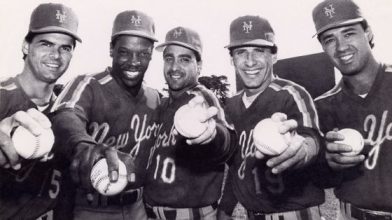
MBTN reader Steven this week found the above image out there in space, showing the Mets’ starting rotation posing in Spring Training of 1987 with new uniforms: Not just the butt-ugly script New York road jerseys destined to be worn in 1987 and 1987 alone, but the centerpiece, Sid Fernandez, wearing No. 10 and not No. 50 that represented his home state of Hawaii and the cop show set there.

Sid’s number change was to be part of a wholesale change in Met pitcher jerseys first suggested near the end of the 1986 season by teammate Ron Darling (right). Darling, who in 1985 switched from No. 44 to No. 12, suggested that fellow starters Fernandez and Rick Aguilera (left) join him, Dwight Gooden (16) and Bob Ojeda (19) with numbers in the teens. When they arrived for Spring Training in 1987, equipment manager Charlie Samuels was ready.

Fernandez famously chickened out of the experiment on the eve of the new season, but Aguilera stayed in 15, which was famously cashiered by George Foster the previous summer. It was one of several changes for the Mets that spring as Kevin Elster moved from 2 to 21; Clint Hurdle went from the 13 he as assigned in his last Met go-around in 1985 to 7 in 1987 (Lee Mazzilli in the meantime was assigned 13); and Ed Hearn switched from 49 to 9. Hearn, like Fernandez, however, wouldn’t make it to the the start of the season in his ugly new assigned Mets jersey: He’d be traded to Kansas City for David Cone.