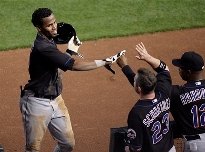
Top Sheff

16Quickly noting here the Mets apparently have signed outfielder Gary Sheffield, formerly of every other team. No word yet on what uniform number he’ll wear but he’s Dwight Gooden‘s nephew, you know, and 16 belongs to a guy whose job will likely disappear because of this, disabled reserve Angel Pagan. Also unclear as of this writing is who will be the immediate victim of Sheffield’saddition.

Still no word on what uniform Sean Green switches to — perhaps he’ll show up in it at Citi Field tonight.

Coming Soon to a Theater Near You

You wanted to see me Sir?


Yes, come on in. We got to do a sports movie and I was wondering what you can get out of this. (tosses book onto the desk)


Faith and Fear in Flushing, by Greg W. Prince?


That’s the one.


Terrific book, sir, I’ve read it myself. And I…


They say it’s like ‘Fever Pitch’


That’s a fine comparison, Sir. Hornby and Prince are both outstanding writers whose works examine how a passion for a sports team becomes an inextricable part of who we are.


Hornby? Who the hell is Hornby? I’m talking about Drew Barrymore and Jimmy Kimmel.


Jimmy Fallon, Sir.


Whatever. Can we get Ben Affleck to play the lead?


Of Greg? I get more of a Paul Gamatti vibe…


We’re not going for Academy Awards here, son. We’re making a sports movie. And get Matt Damon to play his sidekick, Jason. ‘Lethal Weapon’ meets ‘Bull Durham’ I like it.


Well, boss, this is more of a love story.


Then get Drew Barrymore to play the girl.


I’ll call her agent.


And write in a little more drama. Have him have to win her from a Yankee fan. Or maybe from the Matt Damon guy. That’s the kind of spice this picture needs.


But Sir, you don’t understand. It was love at first sight between these two. In some ways, it mirrors the burgeoning relationship between the boy and his team, one that continues to this day.


She doesn’t have to compete for his love with the team?


Nope. It’s about devotion in good times and bad. It’s about what it feel like to be uplifted in 1986 and to bear witness to 1993, on 15 separate occasions.


Well then who’s the bad guy?


Oh, there’s lot of them, Sir. There’s Cesar Cedeno, M. Donald Grant, Benji Molina, Joe Grahe, Keith Lockhart … Page 157 is full of villains from the 1988 postseason alone and it pointedly doesn’t even include Mike Scioscia.


So this Scioscia fellow is innocent?


No, guilty as sin, Sir. It’s just one of many instances in this book where even hard-core fans will be reminded of how much more there were to the stories we all experienced than what may remain in popular memory. This is the testimony of a writer who has seen much, and forgotten little. Quite remarkable.


Yes, yes. But these bad guys? They all get it during the Big Game at the end, don’t they?

No sir. This is a story of the Mets. They’ve won the Big Game quite infrequently, as a matter of fact.

So it’s a tearjerker?

Certainly, some is. It reminds us that baseball, like life, often is a hard thing to endure. We might see ourselves as the awkward child who humiliates himself in a chance meeting with his hero — or the awkward adult whose Mets gear draws idiotic responses in the supermarket. And the story of a loved one with whom we’ve had complicated relationship dying of a terrible disease? Yeah, that one just might hit home. Thanks to the Mets, we all know what it feels like to look at a called strike 3.

Maudlin don’t sell popcorn, kid. Punch it up some.

Don’t need to Sir. It’s actually quite funny throughout. I particularly enjoyed the lighthearted but vicious gutting of Yankee fans in Chapter 23. I’ve taken it upon myself to contact the agent for Stuttering John Melendez.

I see. So how does it end?

They lose the Big Game – and for the third year in a row. Only, and I believe this is the central point, we don’t have to feel bad about ourselves because of it. And we needn’t be ashamed, because that’s what being a fan is all about. This is a story about loving the endings, some happier than others. It’s about being a Met fan. It’s about us.

(Summer 2010)

BEN AFFLECK DREW BARRYMORE PRINCE OF FLUSHING MATT DAMON PAUL GAMATTI and JOHN MELENDEZ as ‘THE UNCLEVER TOOL’ BASED ON THE MEMOIR ‘FAITH & FEAR IN FLUSHING’ BY GREG W. PRINCE

Green Blues

This morning’s Daily News reports that Sean Green — the reliever acquired in the Heilman/Chavez-Putz deal and assigned the same No. 48 previously issued to Aaron Heilman — has requested a new uniform before opening day .

Green, according to the article requested the change fearing fans will associate the number with Heilman and presumably, exhibit the same appalling lack of support and sportsmanship they showed Heilman last year when he struggled. Beside the fact that the Met fan behavior has devolved to a point where that scenario is entirely possible, it sure is ironic that the same fans will likely applaud this act of cowardice from their newest reliever. They are also no doubt the same fans demanding the Mets take numbers out of circulation for accomplished players as well.

To be fair to Green, his number in Seattle, 54, was already occupied by coach Dave Racianello when he arrived, though it’s not as if he possessed the brand equity to dictate that stuff to his new club either.

Anyhow, with the roster now set barring injury, etc., the following numbers appear to be available should Green want one of them: 10, 12, 26, 27, 29, 30, 32, 35, 38, 45, 47, 49 and 50. Many of those numbers would be reserved for those assigned to the minor leagues, so the likely candidates, in my estimation, would be 30 (vacated by Rocky Cherry) or 38 (formerly Tom Martin). Those numbers have cooties too, Green.

We’ll stay on top of this developing story, you can be sure.

Left In, Left Out

22Although recent roster cuts bled the organization of lefties including veterans Ron Villone and Valerio de los Santos, the team hasn’t stopped searching for Portside depth. On Monday, word came they signed Japanaese veteran Ken Takahashi to a minor league contract. Takahashi, who was recently released after an unsuccesful audition with the Blue Jays, is expected to report to Class AAA Buffalo. YouTube video out there shows him pitching for his former Hiroshima team wearing No. 22, now on the back of JJ Putz.

Elsewhere, looks like Rule 5 sidewinder Darren O’Day may sweat out the final bullpen slot, withElmer Dessens and Fernando Nieve his competitors.

Very busy with travel recently, but I plan to resume with the Top 10 countdown after we get through Opening Day: We’ll try to have the new rosters set, new player pages added, etc., later this week.

Would You Buy a Book from this Man?

That’s a request, not a rhetorical question. As many of the readers here know, Greg W. Prince, who co-authors the outstanding Mets blog Faith & Fear in Flushing, has come out with a new book, also called Faith & Fear in Flushing and aptly subtitled An Intense Personal History of the Mets.

I will contribute a full reveiw when I’m finished reading it (I’m up to 1987 now, congratulations on meeting your wife, Greg) but thought now would be a good time to replay my explosive two-part interview with Greg that ran in this space last year. I was way out ahead of the market in declaring Greg a Big Shot then.

I had a fair amount of self-interest in doing this: In addition to pushing my own book, I was also hoping to understand how the heck he does it. The answer: He just does.

Here’s Part 1

Here’s Part 2

Enjoy!

* * *

I consider it good news that Freddy Garcia has agreed to extended spring training and/or a minor league assignment. He obviously wasn’t pitching up to his standards, but perhaps at some point he will, and with the kinds of starts the Mets pitchers have been turning in lately, depth is going to be an issue over the course of a long season. Valerio de los Santos was released and Rule 5er Rocky Cherry — I was rooting for that guy — went and signed with Boston.

* * *

Thanks to those who showed up my chat last night in Roslyn; and to Victor and Rosemary for helping to set it up; and to my sister Jennifer for putting me in touch with them.

Top 10 7s

Our Countdown of Countdowns continues this week with a recap of the top 10 Metliest players ever to wear No. 7. As you can see the pickings are especially thin before a marked improvement in quality – at least, Met-quality – once we get to the top 5. The encouraging if scary thing is that we’re seemingly nearing at a point at which it won’t ever get any better.

Don’t forget, this Wednesday the 25th  I’ll be at theBryant Library in Roslyn, 7:30 pm, to discuss books and baseball and uniforms and other stuff. Stop by if you can… and tell your friends!

10. John Christensen

7John Christensen wasn’t destined to last with the Mets. He was assigned a pitcher’s number – 35 – upon his promotion as a rookie outfielder in 1984 and assumed a player’s number only afterJoe Sambito arrived in 1985 and requested he wear 35.

Christensen possessed decent right-handed power and a pretty good eye at the plate but didn’t make contact enough – with the ball or the Mets’ starting lineup – and the team met his desire for a new start by including him in the 8-player deal for Bobby Ojeda following the ’85 season. The Red Sox would later include Christensen in their trade for Dave Henderson, assuring Christensen would play a small role in assembling both sides of the 1986 World Series combatants.


9. Chico Fernandez

The Mets acquired veteran infielder Chico Fernandez to back up rookie starting shortstop Al Moranin 1963 but neither mentor nor protégé had a year to remember. Born in Cuba, Fernandez came up with the Brooklyn Dodgers in 1956 and had since played with the Phillies and Tigers (where he clubbed 20 home runs in 1962) but by 1963 had suddenly lost it. The Tigers swapped him to Milwaukee when rosters were cut down and the Braves passed him along to the Mets for pitcherLarry Foss.

Fernandez was traded from the Mets’ minor league system early in the ’64 season for Charley Smith.


8. Amado Samuel and

7. Juan Samuel

There’s nothing out there I’ve seen that indicates the Mets’ only two Samuels — not counting Sammy Drake and Sammy Taylor — are related, but both were middle infielders hailing from San Pedro de Macoris in the Dominican Republic.

Amado Samuel, who played briefly for the Mets in 1964, is old enough to be the father of Juan Samuel, who played in for them in 1989, and in one sense, he is – Amado is noted as the having been the very first of the more than 50 players from San Pedro de Macoris to play in the major leagues. The town has since become famous for producing shortstops like Penn State produces linebackers, as well as stars like Sammy Sosa, Pedro Guerrero, George Bell and Juaquin Andujar.

When he broke in with the Phillies in 1984, Juan Samuel looked like he had a chance to be better than all of them. His combination of power and speed made him an exciting player to watch even though closer analysis revealed he made way too many outs to be an effective leadoff hitter and wasn’t much with the glove.

None of that deterred the Mets in June of 1989, when they sent their own flawed leadoff man, Lenny Dykstra, along with reliever Roger McDowell, to Philly for Samuel in a deal that was supposed to electrify the team. Instead, it was a trade they would regret almost immediately. Samuel was used to wearingNo. 8 and playing second base, but the Mets dressed him in 7 and played him in center field (all Samuel’s jewelry were adorned with the No. 8). He stole 31 bases for the Mets, but reached base and hit for power abysmally, and they unloaded him the first chance they got after the season.

Amado Samuel simply didn’t have the ability to stick with the Mets beyond part-time appearances in ’64.


6. Elio Chacon

No memory of Elio Chacon ever gets very far before the “Yo La Tengo” story is retold for the 10 millionth time. And nothing against that story, but telling it over and over seems to have obscured the untold story of why the Mets held Chacon in such poor regard.

Whatever Chacon did to get on the bad side of Casey Stengel it’s a pity, because, without overselling his modest credentials, Chacon was the kind of player the early Mets didn’t see nearly enough of. A speedy Venezuelan shortstop selected from Cincinnati in the expansion draft, Chacon was the first player to wear No. 7 for the Mets. Though he hit just .236 with little power, he drew 76 walks in just 449 plate appearances in ’62 – fifth in the National League that year – and the most walks by a Met shortstop until Bud Harrelson in 1970.

His defense was much derided – the Yo La Tengo story probably contributed to that perception – but the stats show he played every bit as well as the average shortstop in 1962. And despite staying in the Mets’ farm system for years, Chacon never appeared with the big club again, tagged by Stengel among those players who “failed here before” and not welcome back again.


5. Todd Pratt

To me the great shock of Todd Pratt’s signature Met moment wasn’t that he provided it but that Steve Finley failed to prevent it.

Sitting that afternoon in deepest, highest right field we were treated to the realization that Finley failed to come down with that ball an instant before the rest of the stadium did, and to be shouting at the top of your lungs with glee only to be joined by another 50,000 voices was one of the most intense sensory experiences of my lifetime.

Most days, Finley makes that catch. Seemed like his timing was right, but his alignment was off a degrees and that was that. Pratt we knew, had the power to pop one out now and again, serving five seasons (1997-2001) as a capable backup for superstarter Mike Piazza. I always got a “regular guy” vibe from him. With his doughy build and goofy grin, he could be your drinkin’ buddy were he not playing pro baseball.

4. Kevin Mitchell

If you understood nothing else about Kevin Mitchell, and maybe you didn’t, you knew the guy could hit. He hit as a rookie, he hit as a fat guy, he hit as a shortstop, he hit as a pinch hitter. He hit a liner to shallow center with two out and a man on in the 10th inning then came around to score the tying run in the blessed Game Six. The guy could hit.

That Mitchell became an outstanding bench player for the Mets speaks both to his athleticism – he was passable everywhere if not good anywhere – and to Davey Johnson’s creative genius. Though primarily an outfielder, Mitchell played every position but pitcher, catcher and second base for at least part of the 1986 season. Why? Because he could hit: .277/.344/.466 in 364 plate appearances as a rookie.


3. Hubie Brooks

Hubie Brooks was doomed to suffer. He helped the Mets advance from patsies to respectability in the early 80s only to be sacrificed in the Gary Carter trade. And the dynasty he helped establish was in free-fall by the time Brooks returned as an outfielder in 1991 – more or less, as a replacement for departed former teammate Darryl Strawberry.

He was fun to watch and easy to root for, especially in the first go-round. He smacked line drives around the park, played a decent if not value-added third base (and in ’84, shortstop, see Davey Johnson/Kevin Mitchell above) and earned a reputation as a dangerous clutch hitter for a team that was only beginning to establish an offense. I don’t think he particularly enjoyed returning in 1991 after being re-acquired from the Dodgers for Bobby Ojeda, and don’t much blame him.


2. Jose Reyes

It’s only a matter of time before Jose Reyes tops all kinds of lists like these but given that he’s still a young man, and that so much is attainable but still before him, I hope the ascent up Mount Kranepool remains a motivating force.

What else can you say about Reyes? Other than, he’s that rare product of the Met farm system who’s been every bit as good as advertised, and probably better, and that’s considering the hype and how he used to worry me. Reyes fought injuries and a botched conversion to second base in 2004, and struggled to reach base often enough to be effective in 2005 before a breakout 2006 (30 doubles, 17 triples, 19 home runs, a .300 batting average and a .354 on-base percentage) and solid play since.

1. Ed Kranepool

When Ed Kranepool hung up his No. 7 jersey for the last time, the event drew little notice (to be fair, a lot of things that happened in Flushing in 1979 were like that). There was no tearful retirement press conference, just a quiet refusal by the Mets to offer a 1980 contract — sentiment subsequently echoed by the 25 other clubs declining to select Kranepool in the free agent draft that fall. “There was talk of giving him a day at Shea Stadium last season,” a Met publicist told the New York Times the following spring, “but nothing ever came of it.”

He was only 34 years old.

Kranepool at the time held virtually every meaningful offensive record in the history in the franchise, including games, hits, doubles, RBI, and home runs; and was a local boy, the team’s first high-profile amateur signee, the only player to spend every year of the franchise as an active player, and the senior player on the team for 13 years running.

Smart-aleck Met fans of the early 1960s once flashed a placard asking whether  Kranepool was over the hill. Who knew? His career as an everyday player might have peaked as a 20-year-old in1965, when he played a career-high 153 games, and was named to the All-Star team for the first and only time. Kranepool had fair power, but was slow afoot, nobody’s idea of defensive wizard, and reportedly, appeared disinterested and surly from time to time.

The Mets for their part seemed to be forever looking to replace him. He’d be displaced as the Met first baseman in 1969, waived and sent to the minor leagues in 1970, only to rebound with his best overall season in 1971 (143-58-.280/.340/.447 in 421 at-bats). From there he became a part-time outfielder/first baseman and effective pinch hitter for the balance of his career, a role for which he finally won the admiration of fans. Kranepool hit .396 as a pinch hitter between1974 and 1978, including .486 in 1974.

Of all the team-leading career statistics Kranepool’s longevity built for him, his safest record is the longevity itself. No Met spent more time occupying the same jersey number than Kranepool, and it’s not even close. Even discounting the 208 games Kranepool played at the beginning of his Mets’ career wearing No. 21 — no, he wasn’t born wearing 7 — his 1,645 games in No. 7 provides a cushion of 323 games over Bud Harrelson’s lengthy tenure in No. 3. That’s nearly two full seasons.

Fifty-Fifty

Thanks to the contributors who were quick to point out new reliever Fernando Nieve showed up this week in the same uni number, 50, left vacant when Duaner Sanchez was asked to beat it. Junior Spivey in the meantime appears to have been assigned directly to minor league camp and so needn’t officially occupy a big-league number

Nieve is a longshot to make the team and would be subject to waiver claims if and when the Mets send him down, but their timing could be OK if they manage to pull it off while other teams are passing their own guys though. That, or maybe a mysterious arm injury, would appear to be the Mets’ best strategy if they are to hang onto him.

Bullpen jobs are going fast. With each passing day it looks like Bobby ParnellBrian Stokes and Darren O’Day will join sure-shots Frankie RodriguezJJ PutzPedro Feliciano and Sean Green. Like Nieve, O’Day ( a Rule 5 guy) and Stokes (out of options) would be easy prey to enemy claims if they are sent down, so the question is whether Parnell can fight off guys like Ron Villone. Still two long weeks to go.

Don’t forget our meeting this Wednesday, 7:30 pm at the Bryant Library in Roslyn.

He Shall Be Livan

61It’s looking an awful lot like Livan Hernandez will make the team as both its fifth starter and fifth guy ever to wear No. 61, but I’m not counting on that quite yet. It seems to me that if all these opportunities for Freddy Garcia to get torched result in his getting some arm strength back that he’ll still be getting his chances right to the end, especially with Tim Redding likely to start the year on the disabled list and Jon Niese not too impressive so far.

Anyway, I should say I’ve always admired watching Hernandez work — he’s an ox with a full repetoire, likely to throw any pitch at any count and looks like one of those guys who can nicked a few times each night but still hand over a winnable game to his mates and you ought not ask much more of a No. 5 guy.

I’d be lying if I wasn’t a little disappointed that Rocky Cherry hadn’t gotten a better shot at cracking the Met bullpen, but the good news is the Rule 5 pick from the Orioles isn’t headed back to Baltimore so fast. The O’s refused the Mets offer, and the Mets subsequently released Cherry but word is they’re trying to sign him to a new deal and stash him in Buffalo.

The Mets in the meantime are looking to audition pitcher Fernando Nieve and veteran infielder Junior Spivey whom they both acquired in recent days. Nieve is a live-armed lottery ticket snatched on a waiver claim from Houston. He’s had some arm trouble in the past but reportedly brings it in the high 90s. He wore No. 64 in a few appearances with the Astros last year.

Spivey is the former Diamondback infielder (No. 37) and a member of the Snakes’ blessed 2001 World Champs. He most recently was released by the Red Sox in spring training and played independent ball last season. The Mets.com roster doesn’t show these fellas with assigned uni numbers yet — let us know what you see.

MBTN: Live on Long Island

I’ll be speaking about the Mets, uniform numbers, the MBTN book and anything else that comes up next Wednesday, March 25, at 7:30 p.m. at the Bryant Library in Roslyn. I will have a few books on hand to sell ($10 cheap!) and/or sign.

The Bryant Library is located at 2 Paper Mill Rd. in Roslyn. I hope to see you there.

Top 10 8s

8Thanks to a 10-year occupation by Yogi Berra, and an ongoing state of paralysis while the team frets over the implications of retiring the jersey forever, only 14 Mets – just 11 of them players including Yogi who barely qualifies – have ever worn the No. 8 jersey. Needless to say, constructing a Top 10 list is challenging and more pointless than usual. But it’s not as if challenging and pointless are deterrents around here. In fact the following list is even more useful than the others in this series because it can also be read upside-down as a Bottom 10 list. Isn’t that something?

Now, on with the countdown…

10. Rick Sweet

Big mustache, big hair. Very short Met career as a would-be backup to Stearns and Hodges in1982. He had three pinch-hitting appearances in April and was then sold to Seattle, where he happened to have grown up. By mid-season, his No. 8 jersey was on the back of the next man on this list.

9. Phil Mankowski

Mainly remembered as one of the guys we received in the blessed Richie Hebner trade, Mankowski wore 8 only during his 1982 appearance when he subbed at third base for a couple of weeks in place of an injured Hubie Brooks. I definitely have a stronger association with Mankowski wearing No. 2 in 1980 even though looking up the stats reminds me he played very little that year too. Anyhow, by September of 1982, the No. 8 jersey had passed from Sweet to Mankowski to the next man on this list.

8. Ronn Reynolds

Like Sweet, a backup catcher; and like Mankowski, a guy for whom I have two uni-number associations, Reynolds was the third and final wearer of the No. 8 jersey in 1982, thanks to a September recall from Class AA Jackson. Considered a tough, defense-first type of backstop, Reynolds broke camp with the big club in 1983 as Ron Hodges’ primary backup while John Stearnswas out with an injury. He’d go back to the minors once Stearns fully recovered.

Reynolds however wouldn’t return until 1985 – and by then wearing a different uniform, No. 9. The new uni number was because the Mets in the interim had acquired the first man on this list. The lengthy gap between appearances was because of the next man on this list.

7. John Gibbons

Gibbons was the third of the Mets’ three first-round selections in the 1980 amateur draft, and the 24th pick overall. The Mets famously selected Darryl Strawberry with the first overall pick and later got Billy Beane picking 23rd (the additional selections affording the Mets Beane and Gibbons were compensation for having lost free agents Andy Hassler and Skip Lockwood, respectively). It was a fateful haul, with Strawberry destined to become the team’s all-time slugger and Beane a revolutionary team executive. Gibbons would later become a hot managerial prospect with the Mets organization leading to a five-year gig as the Blue Jays manager which ended last summer. Most recently he was named bench coach for the KC Royals.

Gibbons’ breakout season at Class AA Jackson in 1983 (he batted .298/.375/.515 with 18 home runs as a 21 year-old) allowed him to surpass Reynolds among the Mets up-and-coming catchers. The performance had him touted as the heir to John Stearns and Jerry Grote, the latter of whom was, like Gibbons, a product of San Antonio, Texas. Writing in Newsday in 1984, Marty Noble dreamily described Gibbons as “a rookie catcher with ability and eyes bluer than Paul Newman’s.”


But injuries would eventually arrest Gibbons’s progress: A broken jaw in 1984 cost him his first opportunity and he wouldn’t get a second – other than a brief backup role wearing No. 35 in1986. Also in the official records is a September appearance in 1985 when he was issued No. 43but did not appear in a game.

6.  Dan Norman

Here’s another strange thing about Met No. 8s. Of the 11 players on this list who wore No. 8, seven of them also spent time in a Met uniform with a different number on the back. You might remember Dan Norman as a No. 33, which was his number in his first few appearances with the Mets in 1977 and 1978. He eventually got No. 8 when he came up for a lengthier stay beginning in 1979.

Norman is probably best remembered for being the fourth and final piece of the Tom Seaver haul – the only player in that fateful 1977 trade who didn’t immediately join the Mets, and to certain heartbroken 11-year-olds, he held a certain mysterious promise. Norman was a powerfully built outfielder with good numbers in the minors but limited success with the Mets. After a brief trial as an everyday outfielder in ’79, they turned him into a full-time reserve in 1980 and later included him with Jeff Reardon in a deal for another ultimately disappointing right fielder, Ellis Valentine.

5. (tie) Dave Gallagher and Desi Relaford

In order to fit 11 players into 10 slots I needed a tie somewhere so I chose this pair of veteran journeymen, each known for their professionalism and positive attitude.

Dave Gallagher of Trenton, N.J. is among the few Mets of the “Worst Team Money Can Buy” Era not to be remembered poorly. Acquired from the Angels for Hubie Brooks prior to the 1992season, Gallagher had a reputation as a good defensive outfielder and most often was called on late in games to curtail the potential defensive shenanigans the rotation of starters (Bonilla, Johnson, Coleman, etc.) represented.

Desi Relaford was just the kind of bench player a team likes to have: Though he’d failed as a starter and came only at the cost of waiver claim, he was still young (27) and possessed both young player’s skills (speed and the ability to play the middle infield) and the demeanor to re-establish his reputation. His one and only season for the Mets, 2001, would turn out to be the best of his career, and the Mets alertly parlayed into a trade for two players who would help – theoretically, at least – in 2002.

On May 17, 2001, with the Mets getting hammered by San Diego, Relaford entered as a pitcher in the 9th inning and retired the Padres in order on 12 pitches, including a strikeout. We’re fairly sure that event marked the lowest number ever to pitch in a game for the Mets.

4. Chris Cannizzaro

The Mets’ first No. 8 in their history was catcher Chris Cannizzaro, selected in the expansion draft from St. Louis. He was an actual prospect but had missed the majority of the 1961 season after an appendectomy and his future behind the plate was blocked by a kid named Tim McCarver. Were he any more desirable in other words, he would be off-limits.

“I’m glad they picked Cannizzaro, because I’m happy he is getting a chance to play. He is a fine prospect who never had a chance with us,” said Cardinals general manager Bing Devine.

Cannizzaro’s chances with the Mets were difficult to come by too, though by 1964 he’d demonstrate a certain usefulness with a .311 batting average in part-time duty. Cannizzaro would later play for the expansion San Diego Padres and become the first All-Star in that franchise’s history.

3. Carlos Baerga

Met GM Joe McIlvaine by the 1990s for the most part had become a value speculator: His portfolio was full of good stocks purchased at low prices – Gilkey, Olerud and Johnson types – that sometimes paid off big. Then there was Carlos Baerga, whose value was not only down but whose price would be a lot higher than Joe Mac ever imagined.

And that value was down to stay. Although Baerga arrived amid whispers he was more attached to his cellphone than to his teammates, his attitude in New York looked pretty good. It was his slowing bat and expanding waistline that were the trouble. And while it may be unfair to hold Jeff Kent’s future success against Baerga the least he coulda done was outplayed Jose Vizcaino.


Baerga began his Met career in 2006 wearing No. 6 – coach Steve Swisher had the No. 8 jersey then. He moved into 8 at the beginning of 1997 and wore it until his contract expired after 1998.

2. Yogi Berra

Among Gil Hodges’s lasting legacies was a competent coaching staff, the core of which was still doing business together a decade after he passed away. There was pitching coach Rube Walker – who was a former catcher. Joe Pignatano, also a former catcher, tending the tomatoes in the Shea bullpen. And Eddie “The Walking Man” Yost on the coaching lines at third, a superstar of on-base percentage long before anyone really cared much for the stat.

One thing that long-lived coaching staff wasn’t comprised of was future managers, which put the Mets in a bind when Hodges suddenly passed away shortly before the season was to begin in 1972. Bob Scheffing, who himself was thrust to the general manager’s role following a sudden death in the front office, was a former manager but not a particularly accomplished one. He expressed lukewarm interest in nominating himself for the role. The next internal candidate was former Yankee legend Yogi Berra, who’d been fired following his single season managing the Yankees in 1964 and been in the Mets’ employ as a catcher –a few turns at-bat only – and a coach ever since.

As one writer remarked Berra could probably have stayed a Met coach forever – he was that well-liked by players and the media. But subject to the greater scrutiny that comes with the Skipper’s hat, he wouldn’t last forever. Berra in fact survived a lengthy referendum on his job in 1973 and by the end of that year he and the Mets had improbably staved off elimination. But he was fired in 1975 amid the general feeling that the Mets underachieved given their level of talent during his reign.


Asked once the difference between playing for Hodges and playing for Berra, Tug McGraw replied with a murderous quip. “Six innings,” he said. “Hodges in the third inning would be thinking about what he might do in the sixth, while Berra in the sixth was thinking about what he should have done in the third.”

Ouch.

1. Gary Carter

A year ago, while schilling copies of the Mets by the Numbers book at a New Jersey book store, I had a chance for a brief meeting with Gary Carter – on hand to schill his own book. During a brief break in his furious signing activities I presented him with an autographed copy bookmarked at Chapter 8. “Thanks!” he replied with a big smile and firm handshake, as an assistant put the book aside. “I’ll be sure to read it!” and resumed signing.

As I walked away I had two thoughts:

1) That was a really nice thing to say.

2) Could he have possibly meant it?

And I knew right then: I’d definitely met Gary Carter.

I’m on record here as favoring a less-is-more attitude when it comes to number retirement and the ongoing limbo of No. 8 since Carter’s enshrinement in the Hall of Fame is a good example of why. If you’re going to be wavering on it for years, and if you’re terrified that in his next interview the guy’s going to say something that will embarrass the organization, then he probably isn’t a guy whose number deserves retiring anyway.

This is to take nothing away from Carter’s achievements on the field which were sublime and often heroic and make him, by a long shot, the greatest man ever to wear No. 8 for the Mets, much less anyone else. And Carter to his credit was a bit of a freak about it. His one non-negotiable demand upon joining the team was that he be offered No. 8 (sorry Gibbons), a number reflecting both his birthday (April 8) and wedding day (Feb. 8).

We are the World

50So long, Duaner Sanchez. May you forever remind Met fans to fasten their seat belts and not fall in love with relief pitchers. We’ll always have the first half of 2006.

I’ve got issues with the World Baseball Classic but they’re pretty much limited to the non-baseball aspects of it, particularly the addition of ugly sponsor logos to the uniforms, which we ought to know is a trial balloon for this sort of thing on a regular basis, considering Bud Selig is running the thing. However the competition has been great, once again, and fans who pooh-pooh it, no matter how well argued their cases, are missing out.

If it makes Spring Training seem boring by comparison, I’ve got news for you: Spring Training is already boring.For the Mets they’ve so far brought us little more than Sanchez’s release (which could have come last September); some mildly interesting competition for a few bench and bullpen roles which experience tells us don’t tend to matter a whole lot anyway; and health-related terror alerts around three of our projected starting pitchers.

This is not for me.