
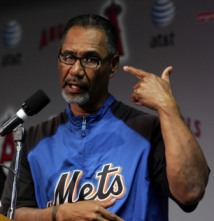
 Clint Hurdle was a one-time “Phenom” of the Kansas City Royals but inconsistent play, insufficient power and probably, a few too many beers (read the extraordinary SI article for details), relegated him to journeyman status by age 25 when he hooked up with the Mets. Hurdle appeared with the Mets in 1983 (wearing No. 33), 1985 (when he wore No. 13) and 1987 (wearing No. 7). Although his contributions with the Mets were modest, the Mets and manager Davey Johnson liked him quite a bit: when he was lost to the Cardinals on a Rule 5 pick in ’86, Johnson was so upset he reportedly cried. The Mets in fact liked Hurdle so much they got him started on the road to managership shortly after he retired: He managed Met farm clubs for 6 years then was hired by the expansion Rockies, for whom he became manager in 2002.
Aside from an extraordinary 21-1 run that vaulted the Rockies all the way to the 2007 World Series, Hurdle’s career in Colorado was remarkable mainly for its length. He is the only manager in major league history to begin his career with five consecutive losing seasons and not get fired. His ability to hang on, many say, was due to a willingness to take bullets for the front office, and for his personal charm. I’ve always enjoyed his guest turns on Mets Extra when the Rockies visited. He wore No. 13 throughout his tenure in Denver.
Those who’ve studied his managerial tendencies have not been impressed, noting an adherance character-building but ultimately witless strategies like the sacrifice bunt. Chris Jaffe of the Hardball Times suggests Hurdle’s most striking tendency as manager “is that he has arguably done the worst job picking batters for the No. 1 slot of any manager in the last half century where the data exist.” After enduring five years of bunt-happy, passive baseball under Jerry Manuel and Willie Randolph, I am sure a change would be welcome.
But if Hurdle’s malleability and charisma can trump his tendency to botch strategy, he might not be a bad choice for the Alderson-led Mets. He evidently is among the finalists.
 Isn’t just like the Mets that they needed to be the dumbest team in baseball for five years before they realized they might need to be the smartest? They’re like George Costanza, author of the above title line, upon the realization that his own instincts had become so untrustworthy he needed to openly defy them by doing just the opposite of what they favored. The Mets have a long history of such behavior, whether it’s sitting on their hands whille the bullpen burned to the ground in 2008 then spending the offseason stuffing the roster with high-profile relievers; responding criticism of moves like the Scott Kazmir trade by aggressively promoting 19-year-old hard throwers to the majors; answering their near-complete tone deafness to the will of fans with regards to the new park by
 Samuels had served as Met equipment manager for 27 years; needless to say he’s a figure whose influence on my little project here commands a good deal of respect. If you wanted to know why this player was issued that number; or why that other guy changed numbers; or what the deal was with those revolting black unis, he was the man to talk to. Only, he didn’t talk much: Through Mets officials, Charlie declined numerous requests over the years to be interviewed for this site and for the Mets By The Numbers


 895:
895: