
Welcome back, welcome back, welcome back…
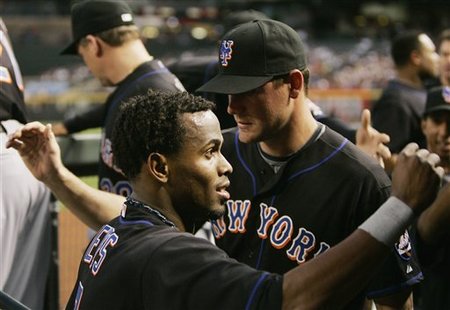
Thanks and good luck to Ruben Tejada, who we’ll hopefully see again soon.
Welcome back, welcome back, welcome back…
Thanks and good luck to Ruben Tejada, who we’ll hopefully see again soon.
Invaluable longtime MBTN contributor Jason E. this morning noted that in making his (losing) Mets debut last night, Hisanori Takahashi became the 30th Met in team history to have made his debut in an extra inning game. Here’s his list, arranged by year and inning, ending of course with the immortal Bruce Boisclair whose debut appearance came during the 23rd inning of a marathon played between the Mets and Cardinals on Sept. 11, 1974 (Bruce pinch ran for Duffy Dyer in a game the Mets would lose 4-3 in the 25th inning as a result of a bad pickoff throw by Jerry CramHank Webb).
I like that this list includes a mix of younguns making their first arrivals on the way to a long career (Rick Aguilera, Edgardo Alfonzo) and guys I’d already forgotten were ever Mets (Ben Johnson). It knocked loose memories of that exciting trade deadline when Steve Phillips went out and traded for a half-dozen relievers (including Billy Taylor and Chuck McElroy) and when Jorge Julio was more trusted than Chad Bradford.
What memories does this stir in you? (And take it away, Jason):
10TH INNING DEBUTS (12):
9/20/70- Dean Chance
9/13/74- Rich Puig
6/11/80- Claudell Washington
4/11/85- Terry Blocker
6/12/85- Rick Aguilera
4/26/95- Edgardo Alfonzo
4/26/95- Blas Minor
8/1/99- Billy Taylor
4/5/06- Jorge Julio
4/5/06- Chad Bradford
5/29/07- Ben Johnson
4/7/10- Hisanori Takahashi
11TH INNING DEBUTS (8):
4/14/65- Dan Napoleon
9/1/70- Ron Herbel
5/20/78- Kevin Kobel
6/1/79-Ed Glynn
4/11/85- Roger McDowell
4/26/95- Ricky Otero
4/29/95- Dave Mlicki
8/1/99- Chuck McElroy
12TH INNING DEBUTS (5):
7/24/62- Bob G. Miller
4/23/72- Jim Beauchamp
9/12/81- Brian Giles
6/27/89- Phil Lombardi
3/31/98- Jim Tatum
13TH INNING DEBUT (1):
9/10/70- Leroy Stanton
14TH INNING DEBUT (1):
9/6/87- Gregg Jefferies
15TH INNING DEBUT (1):
4/7/97- Joe Crawford
16TH INNING DEBUT (0):
(NONE)
17TH INNING DEBUT (1):
9/29/93- Kenny Greer
18TH INNING DEBUT (0):
(NONE)
19TH INNING DEBUT (0):
(NONE)
20TH INNING DEBUT (0):
(NONE)
21ST INNING DEBUT (0):
(NONE)
22ND INNING DEBUT (0):
(NONE)
23RD INNING DEBUT (1):
9/11/74- Bruce Boisclair
Bulletin from the opening-day locker room: Frank Catalanotto has indeed taken the opportunity to switch from the No. 2 jersey he was issued and pounce on Nelson Figueroa‘s abandoned No. 27 jersey. No. 2 — still unissued since 1995!
Ready or not, here they are. It’s been a weird offseason (Omar general managed like someone whose job wasn’t on the line) and an odd spring (thyroid issues, knee surgeries, controversially aggressive promotions, and not nearly enough solid performances, especially from the pitchers) but at 1 p.m. today, they go to war.
I wish I felt a little better about just what this group is going to bring us, but I sort of admire that it was assembled with a minimum of stunts, a good deal from within, and that expectations are back where they probably ought to be for a team with questionable starting pitching, an unproven bullpen and a few too many outmakers in the lineup. But let’s be optimistic on opening day. There a chance we shove it up all their asses. There’s a good crop of prospects on the horizon; and let’s face it, there’s little holding them back. They finally seemed to do something about CitiField’s relentless blandness. Bring it on.
We welcome Ryota Igarashi, Hisanori Takahashi, Jenrry Mejia, Ruben Tejada, Jason Bay, Henry Blanco, Rod Barajas and Frank Catalanotto to the All-Time Roster (likely players 875 to 881). Thanks to the fans who wrote in to inform me that Tejada will wear No. 11 and Mejia No. 32.Chip Hale and Dave Jauss join the coaching ranks for the first time, while Alex Cora, Mike Jacobs and Gary Matthews Jr. return to the Mets in new numbers.
Let’s Go Mets!
PS — Thanks to MBTN reader Glenn below who indicated that this year’s bat boys would wear No. 00.
I’m still having trouble believing that Jenrry Mejia, along with Ruben Tejada, apparently have made the Mets’ opening-day squad and along with the usual caution you should take with all 20-year-olds who’ve yet to play above Class AA, it should be exciting to see what these kids have to offer.
I’m also interested to see what they’ll be wearing. Mejia as discussed below was outfitted in No. 76 this spring and as outrageous as it’d be I’d be tempted to leave him in that jersey both as a reminder of his age and a symbol of his unique place within the Met family. Tejada has apparently won a job the old-fashioned way: He caught the ball better than his counterparts in a competition for a middle-infield job, as compromised as Jose Reyes‘s medical misadventaures made it. He hit pretty well too.
Tejada was wearing No. 79 this spring and will certainly have a new jersey by Monday. No. 3 was recently vacated by Chris Coste and makes perfect sense; 10 (issued to and taken from longshot Andy Green for the second straight spring) would be another strong possibility.
Other late cuts Friday included Kiko Calero, whom I thought would have been a lock if only for his pedigree; hapless punching bag Nelson Figueroa; Bobby Parnell, who had less going for him than Meija a year ago when he turned in two solid months of setup relief; veteran Elmer Dessens; infielder Russ Adams; and reserve hopeful Chris Carter who probably didn’t get a real fair shake at winning a job at first base. The winners along with Mejia and Tejada included utilityman Frank Catalanotto and one of either Sean Green or Raul Valdes. The latter came out of nowhere — he wore No. 96, the highest in camp — to challenge for a lefty specialist role. We’ll try to keep you updated on what the Easter Bunny leaves these guys. …
 As we were saying below, the likely arrival of Frank Catalanotto and the No. 2 jersey he’s been wearing would mark the first time in 15 years that a Met player wore that number in a game. Damon Buford, the last, was a reserve outfielder who was acquired in the Bobby Bonilla trade in 1995 and swapped out for a basketball player the following winter.
Like his father Don Buford, an Orioles star notable in Mets history for his leadoff home run against Tom Seaver in Game 1 of the 1969 World Series, Damon Buford was a compact outfielder out of the University of Southern California. Born in June of 1970, it was likely he was conceived shortly before the 1969 World Series. Like his dad, Damon had good speed and a little pop in his bat, but he lacked his father’s polish at the plate. Over nine seasons in the big leagues, he was a regular in only one year, 2000, when as the Cubs’ everyday center fielder he hit a modest .251/.324/.390 and was replaced the next year by another second-generation outfielder with a Met connection: Gary Matthews Jr.
Back in 1995, Buford was a minor league throw-in in the trade that shed the Mets the unhappy if productive Bonilla, and delivered them a prized prospect, Alex Ochoa, also a minor leaguer at the time. The Orioles, despite Bonilla’s best efforts, fell short of their goal to steal the AL East that year. And while Ochoa stayed in the minors for additional seasoning, Buford was called on right away to assume Bonilla’s position in left field.
The Mets issued Buford No. 2 (Ochoa would be the next to take Bonilla’s No. 25). The jersey had been sitting around since being shared by Wayne Housie and Doug Saunders in 1993, and last occupied by a significant contributor by Mackey Sasser in 1992. The jersey would become something of a regular for the itinerant Buford, who’d wear No. 2 again in Texas and in Boston in the years to come.
Buford had a short window with which to impress the Mets, who at the time were juggling a variety of young outfielders at or near the major league level including Ochoa, Jay Payton and Carl Everett. None really worked out. But despite some promise — in a September game against the Astros he hit two home runs off future Met Mike Hampton — what finished Buford for good in New York was the offseason acquisitions of veteran outfielders Lance Johnson and Bernard Gilkeyto supplement that young core. Gilkey in particular, was like Buford a righthanded hitter and possessed that power-speed combination Buford only might have developed. Within weeks he was swapped to the Texas Rangers for a lower-level minor league outfielder — Terrell Lowery — who was better known for college basketball stardom at Loyola-Marymount: it was his alley-oop pass that Hank Gathers slam-dunked moments before Gathers collapsed and died in 1990. Lowery after one season with the Mets organization was lost in the Rule 5 draft to the Cubs; he played parts of three years with the Cubs, Devil Rays and Giants. Lowery was enticed to leave basketball for baseball by Ranger scout Sandy Johnson, known today as Omar Minaya‘s mentor.
No. 2 was again unissued in 1996 until the Mets fired manager Dallas Green and hired Bobby Valentine. The card at right is shown at the New York Mets Hall of Records.
16 Pagan
1 Castillo
5 Wright
35 Jacobs
44 Bay
12 Francoeur
13 Cora
21 Barajas
57 Santana
Did I just type the opening-day lineup for the 2010 New York Mets?
Yeow.
Add another potential starting point for Ruben Tejada now that the Mets waived, and subsequently lost, veteran backup catching candidate Chris Coste to the Nationals today. Coste was wearing No. 3 this spring (remember Alex Cora switched to lucky 13), seemed destined for Buffalo anyhow and still smelled like a Phillie; he’s no great loss. I know the guys the Mets plan to run out there this year aren’t destined to make anyone forget Mike Piazza, but for whatever reason I’ve developed warm fuzzies for both Rod Barajas and Henry Blanco even with the latter’s douchy forearm tattoos. I dunno. It might have been that article by David Waldstein of the Times a few weeks ago.
It’s looking more and more like Frank Catalonotto will claim a bench role and a jersey that hasn’t been worn by a Mets player in 15 years — No. 2. Can you name that player without looking it up? I couldn’t. Nor could I name the two guys preceeding him. No. 2 in 1996 went to manager Bobby Valentine, and since then then to coaches Gary Pettis and Sandy Alomar.
Steven Z. wrote to say he’s put together an all-time best-by-number list at his blog, Mets Fan Forever (check out also his “best-by-letter” list. You’re welcome to debate or disagree with him there!
Hi, we’re back with the new setup. I did this mainly because the latest upgrade of the content management system we use wouldn’t support the old layout, but the upgrade also provid ed some small upgrades in capability that make the site better and easier to use. For one thing the lists of yearly numerical rosters now progress sequentially and not in that irritating 1, 11, 12. It also allowed me to bust out Superba Graphics‘ terrific alternate logo and provided an excuse to update the records, links, bios and archives through last year (they’re much better organized, particularly the ancient history, though it’s still a work in progress). Some of the comments on recent stories were cut-and-pasted into the new stories, but everything else is just how it used to be. Big thanks to David Moore at Crooked Number for all the web help.
Anyway while this work was going on I kind of slowed down on on the posts right in the middle of what has to be the most interesting spring training, number-wise, we’ve had in a while. A lot of the numbers assigned back in February have gone back up for grabs (3, 22, 32, 36, 43) while guys wearing 76, 78, 79 and 94 have emerged as real threats to take jobs, if not right away then down the road. And more could arrive any minute.
Despite all appearances, I still think the Mets will ultimately send Jennry Mejia to the minors, but I’m not one of those pretend scouts threatening to riot if they don’t. People tend to give way too much credit (or blame) to the manager; I think a man will become what he becomes no matter what his address is when he’s 20. Would he keep No. 76? Unusual but so again is he, and the the temptation to subtly suggest he’s one step beyond Francisco Rodriguez might be too powerful to resist.
Anyway, that’s just one thing worth keeping an eye on as camp winds down. We’ll rap about more soon!
 While we wait for the final peices to fall into place for the big move, we noticed Kiko Calero has been signed to a minor league deal and outfitted in No. 94. He threw a scoreless but shaky inning today. You probably know this already but the Mets got permission to back out of the waiver deal they’d made with the Athletics for Jay Marshall, who was previously assigned 94 (and before that, 47) but never made it to camp as a result of an injury.
Like Marshall, Calero is an ex-Oakland reliever (also a cursed former Cardinal and Marlin) but I like that he’s got more whiffs than inningsand a pretty good careeer ERA, with the caveat that all relievers are crazy crapshoots, especially middling, sometimes injured veteran ones.