Archive for Uncategorized

As You Were

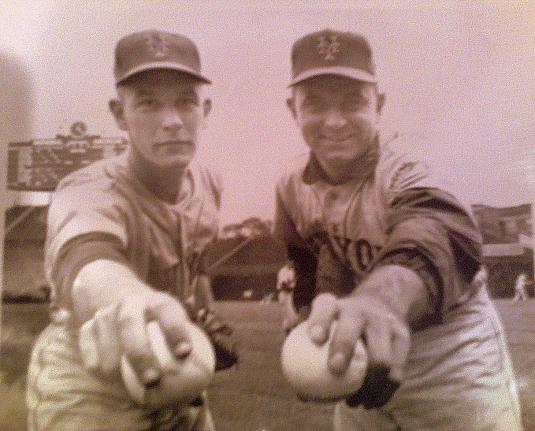
The photo above of the Bobbsey Twins (Bob “Righty” Miller and Bob “Lefty” Miller) comes from our friend Paul, who noted it was a wire photo dated May 8, 1962. The Mets were at Wrigley Field that day, as the scoreboard in the background should give away, and we won — a momentus occasion indeed.

One interesting fact that photo unfortunately doesn’t show is that on that day, the uniform Lefty Miller is wearing was No. 23 — and not the No.36 he’d be dressed in once he appeared in a Mets game. That’s because although Lefty Miller was obviously with the club — he’d only just been traded for two days before, from the Reds for Don Zimmer — by the time the Mets returned from this roadtrip Miller was assigned to the minors and Joe Christopher called up: He’d be wearing No. 23 when Miller returned.

The other gentleman in the photo — like the newest Met, Gary Matthews Jr. — is notable for having been one of 35 men who’ve played for the Mets, then someone else, then the Mets again. Few have made their second go-round significantly better than their first, but Bob Miller did, and we may as well hope Matthews can. Behold the list:


Frank Lary                             1964                      1965                      17
Al Jackson                             1962-65                 1968-69                 15/38
Jim Gosger                             1969                      1973-74                 18/19, 5
Bob L. Miller                         1962                      1973-74                 24/30
Ray Sadecki                          1970-74                 1977                      33
Tim Foli                                  1970-71                 1978-79                 19
Mike Jorgensen                      1970-71                 1980-83                 16/22
Dave Kingman                       1975-77                 1981-83                 26
Rusty Staub                           1972-75                 1981-85                 4, 10/10
Tom Seaver                           1967-77                 1983                      41
Bill Almon                              1980                      1985                      25/2
Lee Mazzilli                            1976-81                 1986-89                 12, 16/13
Clint Hurdle                           1983, 1985             1987                      33/13/7
Alex Trevino                          1978-81                 1990                      29/6
Hubie Brooks                        1980-84                 1991                      62, 39, 7/7
Jeff McKnight                        1989                      1992-94                 15/5, 7, 17, 18
Kevin McReynolds                  1987-91                 1994                      22
Greg McMichael                    1997-98                 1998-99                 36
Bobby Bonilla                        1992-95                 1999                      25
Josias Manzanillo                   1993-95                 1999                      39
Jeff Tam                                 1998                      1999                      38, 36/36
Bill Pulsipher                          1995, 1998             2000                      21/25
Lenny Harris                          1998                      2000-01                 19
Pete Walker                           1995                      2001-02                 49/43
Roger Cedeno                       1999                      2002-03                 19
Jeromy Burnitz                       1993-94                 2002-03                 5/20
Tsuyoshi Shinjo                      2001                      2003                      5
David Cone                           1987-92                 2003                      44, 17/16
Todd Zeile                             2000-01                 2004                      9/27
Roberto Hernandez                2005                      2006                      39/49, 39
Kelly Stinnett                         1994-95                 2006                      33/36
Marlon Anderson                   2005                      2007                      18/23
Brady Clark                           2002                      2008                      15/44
Anderson Hernandez              2005-07                2009                      1, 4/11


  • Twitter
  • del.icio.us
  • Digg
  • Facebook
  • Technorati
  • Reddit
  • Yahoo Buzz
  • StumbleUpon

Reporting for Duty

Quick note on the developing Gary Matthews Jr. trade: If you remember the magical start to the 2002 season,  Sarge Jr was wearing No. 25 for all of one turn at bat and one pinch-running appearance before being traded to the Orioles. No. 25 subsequently went to Scott Strickland when he was acquired days later.

Today, 25 belongs to Pedro Feliciano, and so unless Pedro cares to make a mind-boggling fourth uni-switch in his Mets career, matthews can find something else to wear. He was 24 in his ill-fated adventure with the Angels.

I’m not ready to say this move (reportedly for reliever Brian Stokes with the Angels paying all but$4 million $2 million remaining on Matthews’s contract) completely spoils the “No Stupid Moves” theme for this offseason but it’s not terribly great either. I am thankful they dodged the Bengie Molina bullet, and still think they’ll look for a pitcher via the trade market especially after letting Joel Piniero go. F all once and future Cardinals.

As for Stokes, he did a pretty nice job amid meager expectations, but I think it’s good practice in general to shuffle these middle-reliever and bench types in and out with some degree of frequency.

  • Twitter
  • del.icio.us
  • Digg
  • Facebook
  • Technorati
  • Reddit
  • Yahoo Buzz
  • StumbleUpon

Know Your Millers

They weren’t related but shared a name and a Polo Grounds locker room for the 1962 Mets, becoming one of the mildly amusing sidelights in that sadly comic debut season.


That’s Robert Lane Miller on the left. He came to the Mets in the expansion draft from St. Louis, where he was a 1957 Bonus Baby and though unproven at the major league level, was just 23 with a promising right arm. Observers of the ’62 squad would say Bob L. Miller (No. 24 in your scorecards) had some of the best “stuff” on staff, but they also felt he hadn’t handled adversity well despite getting his share of it with a 1-12 record. He was traded after the season to the Dodgers and quietly began building a solid resume as a relief pitcher. Miller wound up pitching for 17 seasons for 11 different teams — including the Mets again in 1973 and ’74, when he suited up in No. 30. In retirement Miller became the first pitching coach in the history of the Toronto Blue Jays, and was a scout for the Giants when he was killed in an auto accident in 1993.

His roundfaced teammate to the right was Robert Gerald Miller, also a former Bonus Baby (Detroit, 1953) but a lefthanded minor-league journeyman when acquired by the ’62 Mets in midseason.Bob G. pitched exclusively in relief for the ’62 Mets, including five times in relief of Bob L. Miller, racking up a 2-2 record but a 7.08 earned-run average that year, wearing No. 36. He was released shortly after the season and never pitched in the majors again, but confessed to reporters he was often mistaken for his more accomplished teammate.

BIG thanks to longtime MBTN supporter Ed A. for providing the cards (he sent along even more cool stuff we’ll get to). And stay tuned for ruminations on the Bobby Joneses, Pedro Martinezes and Mike Marshalls.

  • Twitter
  • del.icio.us
  • Digg
  • Facebook
  • Technorati
  • Reddit
  • Yahoo Buzz
  • StumbleUpon

More from Japan

My query as to the significance of the No. 18 jersey in Japan got a little more clarification fromDaigo F. of the SABR Asian Baseball Committee. Take it away, Daigo:

When I read the question, first answer that poped in my head, speaking
from my personal experience growing up in Japan, was that its because
Yomiuri Giants 18 has always been “Ace’s number”. But funny thing is
when I looked it up, in my lifetime only two Yomiuri Pitchers has worn
18, Tsuneo Horiuchi from 1967-86 and Masumi Kuwata (also played for
Pittsburgh Pirates) from 1986-2006.

Horiuchi no doubt was a great pitcher, and Kuwata for the most part,
too. Horiuchi is in Japanese Hall of Fame and won bunch of Sawamura
awards and MVPs
.

Other significant pitchers that I can think of who wore 18 are:
Victor Starffin, Motoshi Fujita (both Yomiuri Giants), Tetsuya Yoneda
(Hankyu Braves), Hideki Irabu (Lotte- Yankees) and Daisuke Matsuzaka
(Seibu Lions).

Masahiro “Ma-kun” Tanaka, of the Golden Eagles; and Hideaki Wakui of the Seibu Lions (who said I am not worthy of Daisuke’s 18 at first and wore 16 for a while) wear 18 now, that I can think of off top of my head. Both are considered aces.

On the side note, I grew up rooting for Chunichi Dragons and their
ace’s number has always been 20, and my friend told me for Yakult
Swallows (Igarasghi’s team), ace’s number has aways been 17. So I
guess in that regard, you can’t say 18 is Japan’s ace number entirely
– but because of popularity of Yomiuri Giants, it could be argued.

Also undoubtedly, in high school ace’s number is 1, across the board
(I don’t think anyone would argue that in Japan). Interesting that Yu
Darvish is wearing 11, too.

Anyway, big thanks to Daigo and a shout out to his squad, the Chunichi Dragons. To the extent I have a rooting interest in Japan, I like them in the Central League and Nippon Ham in the Pacific, of course. I certainly was rooting for the Chiba Lotte Marines during Bobby Valentine’s tenure, but reading about the reprehensible treatment at the hands of management goons during his final year, they’ve lost any support from me. As the sign said, “What An Unforgivable Disgrace.”

And not for nothing but it puts this whole Beltran tempest in some perspective. I have to think that the Mets felt betrayed at some level by Beltran/Boras, but they had to know that picking a fight with them was bound to fail too. In any event, everyone ought to do a better job containing their despair and anger at losing an injured guy for a month or two at the beginning of the year.

  • Twitter
  • del.icio.us
  • Digg
  • Facebook
  • Technorati
  • Reddit
  • Yahoo Buzz
  • StumbleUpon

Why Igarshi was Issued No. 18

Thanks to the commenter in the below post who passed along the info, which seemed to eminate from a David Lennon tweet this afternoon indicating the the Mets’ new reliever,Ryota Igarashi, will suit up in No. 18 this year.

Lennon (and a good number of commenters at MetsBlog where the news was dissected and blown up in 45 seconds) focused in on what a crime it was to re-issue Darryl Strawberry’s number — as if they hadn’t noticed they’d given it to Jeremy ReedArt Howe and Craig Paquette, to name only three, in the years since Strawberry left town, and they all missed the real significance of the number to players from Japan.

It’s been a tradition in Japan dating to the 1930s to give an ace pitcher No. 8 or 18. Eiji Sawamura, the 1930s legend for whom Japan’s equivalent of the Cy Young Award is named, wore No. 8 for the All-Nippon team that hosted a team of American stars for a 1934 tour that sparked the creation of a professional baseball league in Japan. Hall of Fame pitchers including Masao Date (an All-Nippon teammate of Sawamura’s) and Motoshi Fujita were 18. The tradition carries to modern players like Daisuke Matuzsaka, who now wears 18 for the Red Sox, and Hideaki Wakui, who today wears 18 for Matuzsaka’s former team, the Seibu Lions, and who this year won the Sawamura Award. The Mets issued No. 18 to their first pitcher from Japan, Takashi Kashiwada.

The passing along of numbers with significance is in my opinion an admirable tradition in the Japanese game and is echoed in pro soccer where its common to see a team’s top player wear No. 10.

Thanks to Rob Fitts, a writer and Japan baseball researcher, whose collection of photos andbaseball cards helped illuminate this post.

  • Twitter
  • del.icio.us
  • Digg
  • Facebook
  • Technorati
  • Reddit
  • Yahoo Buzz
  • StumbleUpon

Still Swinging

All Met fans ought to spend a half-hour with this recent interview of old No. 7, Ed Kranepool, published at Jimmy Scott’s High & Tight. He talks about the end of his career and the doomed attempt to buy the club in 1979; he absolutely unloads on former GM Joe McDonald while speaking well of chairman Donald Grant; andprovides his take on former colleagues and teammates from Seaver to Swan.

Great job, Jimmy!

  • Twitter
  • del.icio.us
  • Digg
  • Facebook
  • Technorati
  • Reddit
  • Yahoo Buzz
  • StumbleUpon

One of Our Submarines

It may not ever come to anything but happened to notice when the Mets today moved to claim lefthanded pitcher Jay Marshall off waivers from the Athletics. Marshall, a true submariner in the Chad Bradford style, continues a trend among Omar Minaya’s Mets teams to include or at least invite a few trick pitchers to camp each year. Marshall this spring will join the lefty-righty siderarm tandem of Pedro Feliciano and Sean Green (and another candidate with an unusual offering, knuckleballer R.A. Dickey). There was Joe Smith and Bradford before that, and guys like Steve Schmoll and Shingo Takatsu were given a shot.
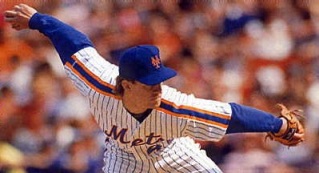
Is this a good thing? I’m not entirely sure. While Feliciano has become one of the Mets’ best weapons vs. rival lefty sluggers and Green and Smith often got grounders when they needed them I’d prefer sometimes they could achieve these successes without also tempting the Mets to try and solve all their problems with matchups and specialists. It can grind games to a halt, for one thing, and all seems so delicate: One specialist springs a leak, and suddenly the whole ship is sinking. We’ve seen it before.

On the other hand, sidearmers are fun to watch when they’re going well and the Mets’ desire to bring these creatures in house indicates some evidence they have a plan, and I like that kind of reassurance.

Innis in the Morning

At any rate, surely we’re in a Golden Age for Met sideslingers. I barely remember a one from my childhood when guys like Kent Tekulve, Elias Sosa and Dan Quisenberry were someone else’s property. David Cone was known to get sideways occasionally, and Jeff Innis was a durable middle-inning submariner for a long stretch, — and there was Jesse –but I’m going blank after that, although I’m sure I’m overlooking a few. Little help?

  • Twitter
  • del.icio.us
  • Digg
  • Facebook
  • Technorati
  • Reddit
  • Yahoo Buzz
  • StumbleUpon

Hall Monitor

As much as I hated his two years with the Mets (and vice versa I’m sure) I take no pleasure in knowing that baseball writers denied Smilin’ Robbie Alomar election to the Hall of Fame. Alomar’s shortfall was one of a half-dozen disappointments the voters delivered today and another blow to the dignity of the Hall of Fame — an institution that’s become harder and harder to take seriously every year.

Andre Dawson — a borderline guy but a feared hitter with counting-stat bonafides — got in while Tim Raines, Bert Blyleven, Alan Trammell, Barry Larkin and Edgar Martinez ought to have but didn’t. As for Alomar, he was a no-brainer even before he arrived with the Mets and his skills summarily went down the toilet. It’s easy to forget his attitiude never won raves even when he was playing well and that his skills never returned even after the Mets cut him loose.

* * *

I got citation from the Police the other day — The Mets Police.

* * *

A MLB.com story mentioned that Jason Bay chose 44 as a tribute to a boyhood idol, Eric Davis. Now there’s a guy whose route to the Hall of Fame took a sudden wrong turn.

  • Twitter
  • del.icio.us
  • Digg
  • Facebook
  • Technorati
  • Reddit
  • Yahoo Buzz
  • StumbleUpon

44 Caliber Killers

Henry Aaron pioneered No. 44 as a number reserved for sluggers, and fellow Hall of Famers Willie McCovey and Reggie Jackson solidified the trend. For the Mets, the 44 jersey has often found its way onto the backs of guys who only think they’re power hitters.

There was Jay Payton, who had all the muscle of a power hitter but a delicate frame and a line-drive bat. Ryan Thompson could hit it out of the park in interviews but was never as ferocious at game time.Lastings Milledge and his similarly powerful mouth wore out his welcome in less than two years (and only 11 Met home runs).Mike Cameron slammed 30 home runs in 2004 but his hardest hit as a Met was a gruesome collison with teammate Carlos Beltran in 2005.

What’s a Met 44? It’s Howard Johnson in May of 1991 switching to No. 44 in an attempt to jump-start his game, only to scurry back to his familiar No. 20 in less than a week when his wife reminded him her jewelry all included the No. 20. It was reserve catcher Harry Chiti, acquired from the Cleveland Indians in 1962 for a player to be named later — Harry Chiti, and the Mets would get fleeced. It was four different players as recently as 2008, and I can barely remember any of them: Brady ClarkTony ArmasEddie Kunz and Brandon Knight. They threaten to join Kevin Lomon and Tom Filerand Bob Rauch, to name three Met pitchers who wore 44 in my fan lifetime and of whom I retain no specific memory whatsoever.

Like everything in Mets history, 44 was good for a stretch in the mid-1980s — Ron Darling and David Cone each wore it before switching to other unis — but it wasn’t long before 44 was again the domain of guys like Tim Burke and John Cangelosi and Jay Bell, who I still can’t believe chose sticking out to the bitter end of the 2003 campaign over retirement, or the Mets for allowing him .

It’s into this dysfuctional family that Jason Bay officially arrived in a Met press event today. Bonne chance, Jason! Ya gotta believe!

  • Twitter
  • del.icio.us
  • Digg
  • Facebook
  • Technorati
  • Reddit
  • Yahoo Buzz
  • StumbleUpon

Bay Day

44Today’s the day the Mets finally hold their first grip-and-grin session of the off-season, welcoming Jason Bay to Flushing Bay. We’ll try to update you on the number he’s issued at our first opportunity but I’ll bet you a date with Suzyn Waldman he gets 44, which is already being pushed by the merchandisers at Met$.com and happens to be available.

More interesting news may be what else the Mets say at the event today, regarding the catching situation (dare we court Yorvit Torrealba again?) and manuevers to acquire another starting pitcher — I’ve long suspected the latter could come via the trade market. But we’ll see.

EDIT: 44 it is, or “two times Bobby Orr,” as Rod Gilbert said. Whew. No date with Suzyn.

  • Twitter
  • del.icio.us
  • Digg
  • Facebook
  • Technorati
  • Reddit
  • Yahoo Buzz
  • StumbleUpon