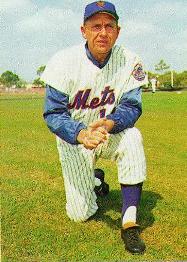
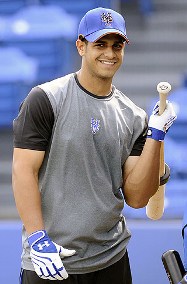
It’s Not Just You: The Greg Prince Interview (Part 1)

I saw the future of rock n’ roll and his name is Bruce Springsteen.”

In the fall of 2000, I’d become a recipient of periodic emails penned by Greg Prince that to me were instantly recognizable as the best stuff anyone had ever written about the Mets. I’d first Met Greg a year earlier after he’d invited me, sight unseen, to be his guest at a Mets game after he’d enthusiastically discovered an embryonic version of “Mets by the Numbers.” I was thrilled when he and Jason Fry launched Faith & Fear in Flushing in 2005, and turned those emails into a near-daily experience for “Met fans who like to read.” In Part I of a recent conversation I had with Greg, he talks about a few things that in my opinion, make his writing the best in baseball blogdom: Total recall, passion and dedication.

Tell me about the prehistory of Faith & Fear. What events led to its birth?
Basically it grew out of a decade of back-and-forth emails between me and Jason. We met on an AOL board in 1994. We had just gotten AOL in my office then, and I had used it for work. One day I was looking around and realized, Oh my god, there’s stuff on baseball here. There’s stuff on the Mets! And that’s where I found the Mets board.

I started posting early in the ‘94 season and Jason and I sort of sought each other out to tell each other we really liked the other guy’s writing. We went to our first game together in 1995 and became really good friends from there. We kept exchanging Mets emails as a matter of course and, as luck would have it, the Mets and the emails kept getting better. Even when the Mets went into the tank post-2000, the emails were still pretty good. A few years later, blogging entered our radar, so we decided to try it.

That was about this time three years ago. We read it, our wives read it, and I didn’t know who else would.

I got involved in some point in an email cell you participated in, which was also pre-blog.

That was a thing I got into during the 1999 and 2000 playoff pushes. I basically wrote to everyone I knew who was a Mets fan, and some people after that added their friends and it kind of grew from there. There were some people from the media who got involved, including a bunch at the New York Times. It was a great way to share the angst and the excitement and dwell on Todd Zeile. You asked out of it at some point later when it got, as you said, just too geeky [I don’t recall this, but when in doubt, trust Greg’s memory – ed.]. There are still about a dozen people in that cell. All of that set the stage for the blog, I suppose.

I wasn’t sure how a blog would do at first. I was familiar with some political blogs, but they were no fun – very edgy and angry. As it turned out we started at around the same time a lot of other Mets blogs had – MetsGeek launched around the same time, and Mets Guy in Michigan and Mets Walkoffs right after us, Metstradamus not much later. It’s like everybody got the bug at once.

I’ve argued that for Mets fans, blogging is sort of an updated version of Banner Day.
Expressing yourself is part of the Mets culture. It’s about taking it personally. I know that Cubs fans and Red Sox fans are said to suffer, but for Mets fans whether they’re winning, losing or collapsing, it’s a truly personal endeavor. A Mets fan wears his heart on his sleeve and takes whatever in his heart and puts it on a bedsheet. Or now, as you suggest, a blog.

Maybe there’s a whole community of Miami Heat fans out there I don’t know about that feels and acts the same way, but to me, being a Mets fan feels unique. It’s not just about “we won, we lost,” it’s about the emotions. By reluctant comparison, I remember somebody sending me an email chain that was going around from Yankee fans when they got Giambi in 2001 and it was so dry, no soul whatsoever. “Hey, I think he’ll be a good hitter. Hey, I think he’ll play first base.” That was when our Mets email cell was going hot and heavy and the Mets were on the verge of trading for Mo Vaughn. Vaughn’s long gone, but our correspondence was a lot more entertaining.

It just seemed to me then and seems to me now that it’s different for Mets fans, a different vibe. The players aren’t strictly movable pieces on the lineup card because our hearts aren’t changed that easily. Not that we don’t all want trades to make our team better, but I think, deep down, a lot of Mets fans – certainly our most hardcore readers – on some level wonder as much about how a trade will make them feel as much they worry about how it will help the Mets win.

Your blog has something new almost every day.

I was surprised to find that some bloggers didn’t blog everyday. It just didn’t seem right.

We try to have something new up every 24 hours. During the season we have something to say about every game, either late that night or the next morning. And in the offseason we get to do more of the historical stuff and the personal stories. I tend to be aware of dates and impending milestones and annual events. If it’s Tom Seaver’s birthday, I try to have something ready for him. For the Hall of Fame induction every summer – even Hall of Fame voting announcements – I might have Tom Seaver stuff for that, too. I like to write about Tom Seaver.

I try to think of myself reading the paper at the All-Star break when I was a kid, and how disappointing it was not having something to read about the Mets. They’d have a little about the All-Stars which wasn’t all that interesting, but nothing about the Mets the day before or the day after. In other words, I want Faith and Fear to be the cure for not having something to read about the Mets.

When we got to the offseason in 2005, Jason and I discussed what we would do about continuing into the winter, and we concluded that it was best to keep it going. It helps to have something like this to get you past the terrible case of withdrawal that the end of baseball season brings. Thanks to blogging, it’s like baseball season goes on for 12 months a year…though after a year like 2007, you may not want it to.

But don’t you ever sit down and find you have nothing to say?
If nothing comes up I just don’t write. There have been dead periods in the offseason, as many as a few days, where we don’t have something new up but it doesn’t happen often.

When there’s no news per se, I go to a running list of ideas I keep on hand. Sometimes it’s just a phrase that popped into my head that I wrote down a while back and will want to explore later. Sometimes I start on a piece, put it aside and come back to it months later. It’s not like I don’t walk around thinking about the Mets all the time, so why not write about the Mets all the time?

It also helps that we don’t limit ourselves, like a lot of blogs might, to wondering what a good trade package is for Johan Santana, or projecting what Jose Reyes’ stats will look like. That can get a little tedious after a while and also, we just don’t know that stuff. We’re not experts. We’d just be guessing.

Your stories rarely fail to remind readers of a little detail or two they might have forgotten. Do you have some secret reference book you refer to when you write? 
No. I’ve managed to fill my head with this stuff, maybe to the absence of anything else. But really, all my life I’ve had a gift for recall. I know it’s a gift because others tell me it is. I didn’t think there’s anything unusual about retaining facts and dates. I assumed it’s what everybody does, but apparently it’s not. In third grade I decided to look up the presidents in the school library and I memorized them right there, one to 37 – it was 37 then, through Nixon. It’s just something I’ve always been able to do. And I am particularly good with dates. It helps to have Baseball Reference and Retrosheet out there now, because I like to be able to confirm what I recall and I’m a stickler for being accurate. I can be quite the nitpicker.

I do keep a log in which I’ve recorded the result of every game I’ve ever attended. I started doing that after I’d been to 15 or 20 or games and thought, I better start writing this stuff down before I forget it. But other than date and score and opponent and starting pitcher, the rest is memory.

What is your sense as to why readers have responded to Faith & Fear the way they do?
One of my least favorite phrases in blogging is, “Maybe it’s just me…” but one of the things that I think has made Faith & Fear work for so many of our readers is they learn, through reading what Jason and I are thinking, is that it isn’t “just them,” that there are at least a couple of people who take this whole Mets thing as seriously as they do, that there are others who let it define a great deal of their waking hours and that it’s all right. That it’s honorable, somehow. That you’re not in it alone.

People like us are not the face-painters, y’know? We’re not putting on wacky costumes and ringing cow-bells and whatever. But we are as rabid about the Mets as any of those types of people and we are paying attention, we are taking mental notes, we are feeling it. I think that’s why we get a lot of feedback along the lines of “I had no idea somebody else” remembers this game or this player or this episode in Mets history in the same way, and that somebody else – in this case Jason or me – thinks about it or cares about it still.

Baseball isn’t vitally important stuff, not like your health and your family. But once you get by those things you are sort of required to care about, you may as well allow the things you enjoy to be important to you. One of the things I think we’ve been able to do is to allow people to feel perhaps less guilty for taking as much joy in a win, or pain in a collapse as they do. It’s OK to feel that way.

How do you see print journalism going?
Taking nothing away from their skills and the hard work they do, I find myself less and less interested in what the beat writers have to say. Every blogger would tell you they couldn’t do what they do without the Times, the Daily News, the Post and Newsday but I’ve stopped buying them every day – and I was a lifelong consumer of papers, from age 6 on. Things happen so fast today, it’s like beat writing has become an outmoded job description.

I think just about every Mets fan has come to hate most of the general and national baseball columnists in this town. There is never any benefit of the doubt given to the Mets and they are the ones responsible for pushing the pointless comparisons to the Yankees. It doesn’t help that a lot of the national-baseball columnists used to be Yankees beat writers and that’s their point of reference for “the way things work” or should work.

The problem with trying to read a columnist today in this age of blogs is it’s obvious the columnist does not think about the Mets nearly as much as we do and goes on to show what an astounding lack of understanding he has for the subject. John Harper, who co-wrote one of the great books on the Mets, The Worst Team Money Could Buy, wrote an absolutely insipid column not long after the season ended on why the Mets had to trade Jose Reyes for Johan Santana – all contingent on throwing money at A-Rod – and he wasn’t going to let good sense get in the way of his narrative. Not to pick on Harper, but it struck me as a rather typical effort: “The Mets will never be as big-time as the Yankees, so they should let go of one of their few assets for somebody the Yankees want.” All praise Omar for not listening.

When I was growing up, sportswriters seemed to be on the side of the underdog. It was the era when New York had underdogs who succeeded, like the ’69 Mets. Now all they understand is success, which is where you get that whole “here’s why the Mets need to be more like the Yankees” thing, which is overbearing and, if you’ve checked October lately, rather futile.


  • Twitter
  • del.icio.us
  • Digg
  • Facebook
  • Technorati
  • Reddit
  • Yahoo Buzz
  • StumbleUpon

I Love the 80s

So we caught the Mets down in Ft. Lauderdale on Saturday, but despite having a great opportunity to chronicle strange and unusual uni numbers, I really didn’t. Sorry about that.

Part of it was that in addition to watching the Mets, I was watching my one-year-old climb the stadium steps and call out the row letters. Part of it was the realization that these weren’t even the Mets but parts of their A, AA and AAA rosters. Of the “regulars,” only Marlon Anderson (wearing No. 9); Ramon Castro and Jorge Sosaplayed, and those guys were through after 6 innings.
The names were as foreign as the numbers, which didn’t help me retain any of it. I mean, I can tell you I saw Nick Evans, Gregory Veloz, Ezequil Carerra, Mike Carp, Ruben Tejeda, Gustavo Molina, Nate Field and Joselo Diaz. I can also tell you I saw Nos. 85, 86, 87, 88, 89, 90, 91, and 97. Just tough to connect the two. Diaz was 74. Field was 66. Willie Collazo was 36, like last year. The thing that caught my attention was Ken Oberkfell, the AAA manager coaching 3rd base in this game, wearing No. 0. So we’ve got some speculative stuff to chew on in the event Willie gets fired.

Oh, and we won by the way, 4-1 over the Orioles.

  • Twitter
  • del.icio.us
  • Digg
  • Facebook
  • Technorati
  • Reddit
  • Yahoo Buzz
  • StumbleUpon

Now on Sale, Vacation

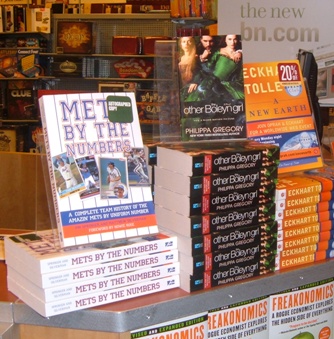
The official release date for the Mets by the Numbers book came Saturday. As clearly illustrated at left, it’s better and more important thanFreakonomics. No really, that’s a short stack of signed copies you can find, while they last, at the Customer Service desk at the Forest Hills Barnes & Noble, 70-00 Austin St. Thanks Pat! Regular, unscribbled-in copies should be in the sports section upstairs.

We’re at work planning a few events around the book release including a launch party and signing appearances in Brooklyn, Queens and Manhattan (so far) which we’ll inform you of as they’re scheduled. If you’d like to schedule an appearance in your hood, please let me know.

Co-writer Matt Silverman is currently spreading the gospel down in Port St. Lucie; I’m heading to Fort Lauderdale first thing Tuesday where I’ll see the Mets play the O’s Saturday, but mainly just taking a short break. We’ll be back Sunday with more dynamite celebrity interviews. In the meantime, I’m happy to pass along this link from my friend Greg of Faith & Fear in Flushing, who makes a pretty strong argument for why you should buy this book, and why you shouldn’t hire me.

  • Twitter
  • del.icio.us
  • Digg
  • Facebook
  • Technorati
  • Reddit
  • Yahoo Buzz
  • StumbleUpon

Marty Noble Interview (Part 3): The Lightning Round

Continued from Part 1 and Part 2

Earlier in our discussion, Marty Noble remarked that uniform numbers were “a background thing,” but something he noticed once they came to the surface. In the conclusion of our interview, there’s definitely an itch to scratch. He riffs on numbers, and stories, with the perspective only a veteran beat reporter could have. This whole interview was a blast, but for me, this part was especially fun.

Are there particular Mets numbers you have specific associations with?
I’d be sitting around the clubhouse and see 23. That’s a favorite of mine. I liked Flynn. I thought Gilkey was as good a teammate as they ever had.


I saw the game after 9/11 on TV the other night and they had a guy in right field, No. 23. I had no idea who it was, as the batting order goes around I’m waiting for him to come up thinking Jermaine Allensworth? He was 23. Finally, I realized. It was Matt Lawton.


There’s a study that says when you like something, there’s a secretion in the brain that makes it stick in your head. If you hear a flip side of a song you like, you’ll remember that too because you like the song it’s attached to. So it’s weird. Matt Lawton was unfriendly. He wasn’t a bad human being, but he was unfriendly. I don’t want to think of him.


That turned out to be such a bad trade, for Rick Reed.
Don’t tell me what his number was. He wasn’t 34 or 36…


He was 35.
Billy Beane wore 35. I like him, so I remember that.


That’s right.

34 was always a nondescript pitcher.. The first 34 I met was Apodaca. There was one year they got into late August where he hadn’t even appeared in a victory.

Things are starting to come out. When I see six, I see Darryl Boston.


38?
Tim Leary.


2?
Sandy Alomar. I wouldn’t want Bobby Valentine to know I thought of him. Marv Throneberry was 20 with the Yankees and 2 with the Mets.


6?
My six is Wally. Al Weis is probably the most important 6 in Mets history.


19?
Has to be Bobby O. Though Gardy is a special guy, I love him. In fact, I’ll put Gardy above Bobby O.


20?
I’m drawing a blank. Hojo is 20 but he’s not the one I want. I like Hojo. I like Shawn Green a lot. Ryan Thompson was fun.


27?
Swannie.


28?
My 28 is Bill Robinson.


That’s a good choice. Robinson has been there as long as any player. Except maybe John Milner.
Milner was lazy. He had a bathrobe that was Howard Johnson colors: orange, turquoise and white. He could have gone 60-for-60 in the previous weeks but if he had that bathrobe on, he wasn’t playing. If he had gone 0-for-48 and didn’t have the bathrobe on, he was playing. He wouldn’t say anything. If he had the bathrobe on he’d just walk away. Not a nice person. He once had a wine bottle by the neck and threatened me with it. I called him “the Hamper” not the “Hammer.”


You’re ruining my childhood memories.
He wasn’t a good guy.


How about 33?
Ron Hunt, but Hondo was the big 33 for the Mets.


Actually, Hondo was 55, not 33.
My mistake. I’m seeing him hit against Whitey Ford.


He and Frazier were both managers who wore 55.
I remember Frazier wore 55. Frazier was a misfit. Very nice guy, but completely over his head. He had no sense of New York. He attacked Tom Seaver on the bus, not physically, but he got all over him. If you’re the manager of the Mets in 1976, you can’t do that.

It’s actually part of a funny story. Remember Augie Borgi? Augie was the Daily News Mets writer for years in the 1970s including 1976. Augie was the cheapest man on the face of the earth. No one was remotely close. We were in the bus, coming out of LA into Chicago. Seaver is on the same bus as Frazier, and the manager is a little loaded, and he got on him, calling him Seavers, saying, “I wouldn’t be saying too much if I was pitching like you’ve been pitching, Seavers.” We all wrote this story afterward that nobody had ever spoken about Seaver that way. Augie was right there but he didn’t write it. Why? Because he wanted to put in for a cab fare. Now that redefines cheap!


43?
My first that comes to mind is Paul Siebert. He comes to mind, I can’t tell you why. The other one that comes to mind is Spider Lockhart but he didn’t play for the Mets. Who else wore 43?


Remlinger…
I liked him.


Paul Byrd…
Didn’t remember that.


John Hudek…
God, no.


49?
Benitez comes up. He’s not my favorite but he comes up. What did Mike Bruhert wear?


He wore 26. He was the first 26 after Dave Kingman.
I remember Kingman wore 26, and 10, but 10 may have just been spring training [it was]. Rusty wore 4 and 10. But my all-time 10 is Kelvin Chapman. He wore 10 as a kid when he first came up in 1979, then 11 in 1984 when he came back up. Maybe he changed because 10 was bad luck.

Kelvin Chapman was a great kid and the best basketball player they ever had. Better than Strawberry.


I read somewhere that he has a son who’s a well-regarded prospect.
I wouldn’t doubt that. The Mets wanted him desperately to become a coach. They thought he’d be a great manager. He was as personable a guy as you’d ever want to meet. He and Xavier Nady are two of the most popular people in the clubhouse I’d ever known. Chapman couldn’t touch right-handed pitching but he could really hit lefties and Davey loved him.


Davey rescued him from several years in the minors and in the process turned away guys like Brian Giles.
He should have been turned away. He had skills but he didn’t want to play. And he didn’t want to stand close in the batter’s box. He stand as far back in the corner as you could be. Balls on the outside he couldn’t hit with a telephone pole. Defensively he could do things that most people couldn’t do, but he was afraid of the ball at bat.


29?
My first thought goes to Bud Daley, a Yankee. 29 was Viola who I didn’t like very much. And Magadan who I liked a lot. Very good guy. Very good hitter and a good hitting coach from what I hear.


The Mets didn’t believe in him. They had Hernandez who was a slightly better version of him…
Slightly? Hernandez was the best player I ever covered. He made his team win more than any other player. He was a good interview, and we’re friends today, but when he played he never, ever gave me stuff. I still get on him for that. He never helped me! He gave me nothing. I don’t care if you didn’t give it to anybody… give it to me! Keith would give you opinions but wouldn’t give you facts. I don’t think he gave anyone facts.


Who’s on the all-interview team?
Glavine is No. 1. He and Joe Torre are the best interviews in the game. Keith would be No. 1 at first. Wally was great. He tell you to come over and trip you. At shortstop, Elster was great. He saved a quote for me one day. In Chicago, in 1991, they had lost 9 straight games and I walked into the clubhouse and Elster said to me, “Before you go into Buddy’s office, I have to tell you something. I’m saving this just for you.” He said, “You know what makes this so good?” meaning losing 9 in a row on the road? “We just cut four and a half innings off the season.” It was great, and I wrote that. The next day Buddy came to me and he said, “I’m not accusing you of making this up, but did he really say that to you?” I said yeah. He said, “I have no control of my players, do I?” And he didn’t.

At third base, David is not there yet. Hojo was OK. He was good at first, but got too cautious after a while. Roy Staiger wasn’t any good. Hubie didn’t say much. I have to go with Ray.

Left field, no one liked McReynolds as much as I did, but he wasn’t a great quote. Alou is very interesting sometimes but not always. Kingman was a pain in the ass. Foster was a bigger pain in the ass. Gilkey would be the guy.

Catcher would be LoDuca though Todd told me more than LoDuca would. LoDuca was a good quote. Center field had to be Lenny. He’d say anything. Though Brian McRae had the quote of the century. When they lost five straight games at the end of the 98 season, after they were shut out by the Expos he said, “Everyone plays us like the World Series. They want to kick our ass because they hate our manager.”


I remember that quote.
We all went down after that and talked to Felipe, who denied it. But Bob Nightengale of the LA Times was in Houston and heard about this quote and after the game and went to Moises Alou who said, “My dad hates Bobby. Are you kidding? He wants to kick his ass!” So he called me, and we had it confirmed!

Right field? Bonilla never did anything but lie. Burnitz was no good. Straw was Straw. He could be manipulative. Rusty was very condescending when I covered him. Now we’re good friends but then, he was a difficult. Shawn Green is actually quote good.

Relief? Franco was tough. Neil was loose-lipped. Tug was spectacular every day. Billy is good when he pitches like shit. But Tug was amazing.


Did Wagner’s criticism of Willie and Peterson ring true to you?
Yes. They moved Sosa to the bullpen which was a good move but after that I couldn’t ever figure out who they were going to bring in. You see guys warming up who wouldn’t come in. There may have been injuries we didn’t know about – that’s often the case.


Do you find Willie a little churlish?
I get along great with Willie. I’ve known him since he was a baby. But I have to be by myself. If I’m by myself he’ll tell me anything. But in a group, once in a while I think I can read him.

Remember two years ago when Feliciano shot his mouth off? I remember the next day I could tell Willie wanted to say something but he didn’t want to be the one who said it. So I asked, is there anything else you want to say about this and he later thanked me for allowing him the opportunity to say this – he said, “I’ve been around winners all my life and winners don’t do that.” What an incredible way to assert himself and not rip Feliciano, but say what had to be said. I thought it was a genius quote, I couldn’t think of a better thing to say.

We have a system that allows what I can write without his name, what I can write with his name, and what I can’t write. It used to be that way with a lot of guys but the world has changed. Part of that is that there’s more Spanish guys who don’t trust you or just don’t know how to say the things that need to be said. There are also guys who just don’t want to deal with us.

But Wally would say anything. Remember the fight with Eric Davis in ‘86? We came in to the clubhouse afterward and Wally was there and said, “Come here, write this down.” And he motherfucked George Foster for an hour! That motherfucker wouldn’t fight. Danny Heep was out there fighting in his underwear, and George is on the bench. Fuck him. Write it! And say I said it!And I did.


You’re 59 years old, and approaching 40 years covering baseball. Do you have plans to retire?
I have no plans yet, not while I’ve got a wedding to pay for in September for my daughter, and another daughter still in college.

Again, I’d like to thank Marty for being so generous with his time and his opinions. Met fans in general — and this site in particular — owe much to his style and spirit while telling us how it is.


  • Twitter
  • del.icio.us
  • Digg
  • Facebook
  • Technorati
  • Reddit
  • Yahoo Buzz
  • StumbleUpon

97% Baseball: The Marty Noble Interview (Part 2)

In the second part of a 3-part interview, veteran Mets beat writer Marty Noble and I discuss recent Met history with uniform numbers again providing the backbeat. It should be noted this conversation took place in January, shortly before the Johan Santana deal brought a decidedly sunnier outlook to me at least. Thanks again to Marty for his cooperation and candor.

What’s your sense of Charlie Samuels’ power in the clubhouse?
Every clubhouse has a guy like that. Del Webb and Dan Topping didn’t decide what number Mickey Mantle wore: Pete Sheehey did. I know of clubhouse guys, not on the Mets, who wouldn’t give a black player a number that belonged to a racist white player.

Someone wrote me an email once that suggested the Mets only issued No. 21 to black players.
Spahn says that’s wrong. Elliott Maddox? He was 21. Cleon Jones. Bill Pulsipher, Yoshii. Cleon is the first 21 that comes to mind for me. Pulsipher – he was special guy. I wish he’d filled 21 for 20 years. I don’t know anyone who enjoyed the game more than he did. Loved every second of what he was doing. He was strange and crazy and sometimes, not always crazy in a good way, but he loved the game, and I respected him. I liked him a lot.

Terry McDaniel?
He was zero.

Do you remember why?
No. Do you?

No. I thought someone must have had a reason for that.
I remember what Rey said when he didn’t want to be zero anymore: I want to be more than nothing.

He’s that, all right.
I liked Rey. He trusted me. If you drew a circle around second base seven feet in diameter, there was never a guy who played that area of the field like Ordonez. Nobody. Not Ozzie, not anyone I ever saw.

Seemed that he could have been a more useful offensive player than he turned out to be.
Yeah. Part of that was him bulking up too much, part of that was Valentine. They should have told him, just catch the ball. He wasn’t much more than inept than Belanger, who had one good year as a hitter. But Bobby always had to fix somebody. That’s part of the reason Jay Payton didn’t like Bobby: He didn’t want to be fixed. But he wouldn’t come to him for help and Bobby wanted guys who came to him for help.

It was my impression that Valentine was a Payton guy.
Oh no. Not even close.
Bobby was a great coach of hitting. I remember doing a piece the first spring he was there, where I followed him from field to field over 60 minutes. One of the things he did in a very brief period of time was teach Fonzie how to hit the inside pitch to right field with power. And Fonzie was amazed at what he’d learned. He was not someone who ever raised his voice, but he was stunned that Valentine knew so much.

Valentine also helped Agbayani become a very efficient hitter against lefthanded pitching. But if you didn’t go to him, he wouldn’t want you. A young player would have to worship at the altar before Bobby would accept him.

Do you remember what number Payton wore?
25 and 44.

Guys who were 44 tended to want to be power hitters.
Ryan Thompson, for sure. But not Jeff Reardon. Payton was a line-driver. I’m still disappointed at the career he had because I thought he was going to be a stunning player. He lost significant time to injuries. To miss two years when he should have been learning in the minors was a shame. He and Paul Wilson were very hard workers, it’s a shame that so little went their way.

Wilson wore 32.
As did Matlack, Tom Hausman and Mike Stanton.

Stanton was like Glavine – no Met fan’s favorite Met.
But he was a pro and gave you all he had every night.

As a fan, I found that the celebration of Glavine’s 300th win was way over the top. He was a guy whose equity was still with the Braves.
I don’t think it was doing anything more than getting people in the park. It was also because he and Jeff were very tight. I have great regard for Glavine. The fans said awful things about him.
[Glavine] said he was not devastated. He probably shouldn’t have said it. What he said was, I’m disappointed beyond belief how I performed but I’m not devastated. That’s not how to be.

But contrast what they did for Glavine with what they did for a guy like Alfonzo, who by the time he left the organization was well up there among the leaders in all the offensive categories and was beloved by all the fans.
Well this was 300 wins and for Fonzie the equivalent would have been 3,000 hits and he wasn’t close to that. To some extent these things are about selling tickets. The Yankees had Elston Howard’s number retired to sell tickets. Obviously the last game will stay with his image forever. But without him, they don’t have a chance and I don’t know how they’re going to replace him.

The Mets always say they want a guy who knows how to pitch, but as soon as the Mets get one they trade him for Ambiorix Burgos. Bannister was going to be a good fit. But Omar thinks of guys who can throw a ball through a wall.

Frank Cashen could open a drawer, take out a piece of paper and show you who would be on the team in three years. I don’t think Omar could tell you who’s going to be on the team in April. They don’t have anything down below. They lost Flores last year knowing they didn’t want to have LoDuca around. They have nobody to be a first baseman and they won’t want to pay Delgado after this year. What happens if Pedro leaves and there’s a good chance he will? I’m not big on what he does.

The feeling I get as a fan was that they were getting a little better at looking at things ahead of time, putting resources into the organization that they hadn’t before Omar arrived.
I think they are devoting resources. But they still have to have a catcher. They don’t have a first baseman. I don’t expect Delgado is going to do that much more than he did last year.

What about Mike Pelfrey?
Hard read. More awful times than good times. But that game against the Braves was fantastic. I’d tell Pelfrey you have 25 starts. And if you’re horseshit after 25 starts we’ll have to look at it. I think they have to do it that way. You don’t know what you’re going to get with Pedro. He could break down anytime. I don’t trust Perez. I was wrong on him already; I didn’t think he’d be as effective as he was last year. You know Perez is just waiting to go 12-17.

He wears 46. That doesn’t portend good things in Mets history.
Who else?

Neil Allen, David West, Terry Bross, Brian Bohanon, Willie Blair…
Bohanon is one of those guys who Bobby Valentine made better. Blair gave up that home run to McGuire.

Rich Rodriguez…
46One of those relievers they brought in. Like Jeff Musselman or Ricardo Jordan. Jordan came over with Toby Borland in the Rico Brogna deal and shit the bed against the Padres in Bobby Valentine’s first opening day as manager. They gave up 11 runs in the 5th inning. But the great thing about Ricardo Jordan was that he had a sister called Lucy. So we had Lucy, we had Ricardo. We had little Ricky Otero and Desi Relaford all in a period of four years. And I put it all in a story and wrote the headline: Meet the Merts.

When is your book coming out?
Never. I don’t have the time for one, but also, I don’t want to be put in a spot where I can’t use the best stuff I have. I also don’t want to offend some guys. I have some Doc stories that might not shock people, but would intrigue them. But he’s had enough. And there’s some good stories about Wally. But maybe some things are best left unsaid. I grew up in that time where we knew Mickey Mantle hit home runs and were probably better off not knowing that he drank.

Remember that whole mess when Izzy said something supposedly anti-Semitic into the telephone? It was ’97, we were in St. Louis, and he’s on the DL, not even at the ballpark, and Jay Horwitz has a conference call. And because Jay can’t function with anything mechanical, he hits the wrong button on the phone, so instead of hitting private he hits speakerphone and Isringhausen – a great German name – says, “Yes, Jewboy?” That was the full extent of it. Every one of the writers knew that Jay communicates with his players that way, saying, “I’m the Jew!”

All of a sudden one of the writers said Tom Hill was going to go with it. Then Buster Olney goes to his editor at the Times and says, “Someone said ‘Jew.’ Should we go with this?” Now everybody had to do it, and all it did was cause shit and nobody got any benefit from the story being written. It offended every Jew in the world: Those who didn’t like what Jay did, those who think every German hates Jews, and those who aren’t Jewish or German. I had lots of stories I could have written that day. Instead my editor, without my knowing it, added to my story that it wasn’t the first time the Mets have been accused of anti-Semitism, and quoted something from Nelson Doubleday in John Helyar’s book Lords of the Realm. And so now Nelson’s furious at me.

Who runs the team today? Fred or Jeff?
Jeff. He’s OK. You don’t have to be his friend, but you wouldn’t want him as your enemy. He’s doing the right thing. He’s trying to make the team good. And they’re not cheap.

Does the Lastings Milledge trade reflect any threats to the longterm security of Omar?
I think the Milledge trade was 97% baseball and 3% they didn’t have the same sense of reluctance they would have had had he not shot his mouth off and done stupid things. It’s been little things with him from the day they got him. But he never got it, and I don’t think they believe he ever would have.

All he ever had to do is say “Oh, yeah, you’re right. I screwed up.” I don’t think he could do that, and I don’t think he ever reallybelieved that. You may not think there’s anything wrong with what you do, but if all the people think that, then you have to at least acknowledge it.

He also couldn’t play center field in New York because Beltran was here. When you have the high profile he had and start making errors in New York it’s a bigger story than if Ryan Church makes an error. And I don’t think the Mets thought he was capable of handling that. They made a good deal I think.

Church has nice numbers but appears to cry out for a right-handed hitting platoonmate.
So they go with Easley.

What about a guy like Nady?
I d take him back in a heartbeat. When he left here two years ago he was fourth in league in RBIs that tied the score and second in the league in RBIs that took the lead, and this is while missing a few weeks for an appendectomy and playing with a broken wrist. Omar said he didn’t catch the ball real well but neither did Shawn Green.

Is Delgado going to have a better year?
Hard to tell with him. He had those periods last year where he didn’t get beat on fastballs, and also those where he couldn’t catch up. He’s a curious guy. I thought he’d be a real great pickup in terms of helping others along the way but he really keeps to himself. He’s not a clubhouse force.

Wright seems to me that kind of guy who’ll accommodate anyone with a microphone and a notebook.
David is perfect. He may be the perfect player in every way there is. I was around Carter and Carter did a lot of the things David did, but you got the idea that Carter did those things because he wanted people to think he was a nice guy. David does it because he is a good guy. It’s astonishing.

Coming in Part 3: Marty faces THE LIGHTNING ROUND!

  • Twitter
  • del.icio.us
  • Digg
  • Facebook
  • Technorati
  • Reddit
  • Yahoo Buzz
  • StumbleUpon

The Whole Nine

I’ve enlisted Todd Hundley and Gregg Jefferies here to help celebrate the 9th birthday of Mets by the Numbers. (see a broken-linked proto-page from our rookie year of 1999 here. Go, Terrence Long!)

As I’ve recounted previously, the site when it launched was sort of a personal project to see whether it was possible for a fan (me) to remember the uniform number of every player who ever played for the Mets. Of course, it wasn’t. I in fact wasn’t even close to rememering every player who played for the Mets.

Fortunately for me, right around the time I was putting together this page for the first time, the Internet had sprouted another data-driven Mets site, the Ultimate Mets Database.Subsequent discussions with UMDB’s creator indicate our sites couldn’t have launched more than a few weeks apart at the most. With help from that starting point, and later, a small audience of devoted followers, we eventually got our act together, but as Wes Westrum might say, it was real cliff dweller.

  • Twitter
  • del.icio.us
  • Digg
  • Facebook
  • Technorati
  • Reddit
  • Yahoo Buzz
  • StumbleUpon

Torve Jackpot! Fight Night in Photos

You may have seen a few posts back the exclusive interview with Kelvin Torve, whose “accidental” issue of the 24 jersey in 1990 caused a minor stir among Met fans and a major event in team history when viewed through the numeric prism. Photographic evidence of the event was difficult to come by, to say the least — even a thorough re-examination of Mets Inside Pitch issues from 1990 produced nothing.

That was before MBTN user TommieCleon (aka Paul C) stepped up to the plate, and just like Kelvin Torve on Aug. 9, 1990, smashed one off the wall. Pictured Torve slams a double to the gaphere are videocaps from that historic occassion — not only one of the few games Torve spent wearing No. 24, and not only his best moment — his pinch double drove in 2 runs including the game-winner and made him a hero — but for the lengthy, violent, bench-clearing brawl that occurred only an inning before.

The brawl was precipitated when Phillies pitcher Pat Combs returned fire to Dwight Gooden, then hitting. Gooden earlier in the game had hit Phillies Dickie Thon and Tommy Herr with pitches. Tension between the Mets and Phillies had dated to a year before when Darryl Strawberry and Darren Daulton tangled.

standing at secondGooden charged Combs after the pitch struck him in the leg in the 5th inning. “You go with your first reaction and mine was to get him,” Gooden later recounted. The ensuing melee, a “Pier 6 Brawl” as Bob Murphy might describe it, lasted nine minutes and halted play for 20. Strawberry went after Daulton but was interrupted by Von Hayes and they went at it. An obscure Phillie reliever we’d come to know, Dennis Cook, was yanked from the pack and thrown to the ground by umpire Joe West, and then he really got mad. Met outfielder Kevin McReynolds wrenched his back in the scrum. In all six players (Strawberry, Gooden and Tim Teufel for the Mets; and Combs, Daulton and Cook for the Phils) were ejected, along with Phillies bullpen coach Mike Ryan.

Dwight Gooden: "My first reaction was to get him."Expect this game to be referenced often as talk heats up of the Mets and Phillies renewing hostilities this season.

As for Torve’s role in the number controversy, Paul has this to say:

Based on materials in the public record concerning the Mets issuance of uniform #24, I think that present management is not inclined to retire the number. Of course, this is somewhat obvious based on the simple fact that the Wilpons still haven’t retired the number in the almost 30 years that they’ve owned the ballclub. Still, Kelvin Torve might have been a guinea pig in a calculated ploy to gauge public sentiment over the reissuance of #24. Perhaps there is a better explanation for Torve Dwight throws a right on fight nightas #24, but to me, the notion that either Charlie Samuels or Met management forgot about the significance of reissuing the number is simply implausible, no matter how momentary this alleged lapse in memory was.

The Mets solution to this uni controversy appears to be a compromise; keeping the uniform mostly in limbo is consistent with their own view against retiring the number. By allowing the uni to be reissued to a special player, (e.g. Rickey Henderson, a first ballot HOF’er and one of the two or three dozen best players of all-time), Met brass appears to be minimizing instances of fan disappointment. After all, one would think that the benefits of acquiring that special player would outweigh whatever negativity might arise from having that player wear #24.

Keith Miller is the first to arrive as Gooden gets double-teamed. Good wheels, Keith!As you admire this awesome collection of historic Met bloodshed which Paul was cool enough to provide, give some thought to his points above: What should the Mets do with 24? How cool was this brawl? And how awesome do the numbers look without the awful drop shadow?

Comments below!

Kruk can't hold back Strawberry...


...But Von Hayes can, for now...


Handicap match for Strawberry


What do you mean my haircut sucks?!?


Nine minutes, 6 ejections and a guy wearing 24


Dutch Daulton arrives at the Gooden-Combs match


Daulton throws a right: But who's brain-damaged now?


That's Dave Magadan amid burgandy Ponys and Reeboks


Psycho reliever Dennis Cook tangles with umpire Joe West


Gooden's plunk of Tommy Herr sparked Philly retaliation


The scoreboard tells of the aftermath


  • Twitter
  • del.icio.us
  • Digg
  • Facebook
  • Technorati
  • Reddit
  • Yahoo Buzz
  • StumbleUpon

Flying Coach

As we’d been expecting to see, hitting coach Howard Johnson has cashiered No. 52 and returned to the No. 20 jersey he last wore as a Met player 15 years ago. Bullpen coach Guy Conti in the meantime switches from 56 to 52, allowing bullpen pitcher Juan Lopez to take 56. We hadn’t nailed down Lopez previously.

Bullpen catcher Dave Racaniello in the meantime was spotted wearing54, as noted below, and catching instructor Sandy Alomar Jr. has slipped into No. 90. These changes have been added to the handyclip-n-save Spring Training Roster above. Many thanks to Bryan, David, Chris and other commenters for the updates.

Big thanks also to MetsGrrl for pointing out how difficult it was to get in touch — turns out I’d mistakenly “turned off” the contact link. Duh.

  • Twitter
  • del.icio.us
  • Digg
  • Facebook
  • Technorati
  • Reddit
  • Yahoo Buzz
  • StumbleUpon

Like the Flip Side of a 45: The Marty Noble Interview (Part 1)

There’s hardly a Met fan alive who hasn’t been told at least some of the team’s story by Marty Noble. The reporter, who today writes for mlb.com, is now beginning his 38th season covering Mets baseball, and traces of that history inhabit nearly everything he writes. Much of his best stuff can be found around this time of year, when he’s the only writer who’ll get a story out of whichlockers are occupied by whom and, as always, his readers will learn a thing or two about uniform numbers – a topic that he’s definitively chronicled, albeit in passing, for as long as I’ve been reading the sports pages. It was a thrill to contact Marty, first to solicit a blurb for the Mets by the Numbers book, then for an interview that became a lengthy conversation, and then another. Following is part 1 of a multi-part series. Enjoy!

Remind me of your background in journalism.
My first professional job was in Vermont but in 1970 I began working for the Herald News in Passaic, which has since been overtaken by the Bergen Record. I worked at the Record from July of ‘72 through the end of 1980.

I covered the Mets and the Yankees then, split almost 50-50, all their home games. I covered the Yankees only the road when they were close [to the pennant], so that meant, no Mets in ‘76, ‘77, ‘78 and ‘80. I also covered the Yankees on the road in 1974.
Did you aspire to be a baseball beat reporter?
I worked for a paper but didn’t have any thoughts of covering baseball. Then in ‘70, I covered my first game and in ’74, with the Bergen Record, they said, ‘You’re going to cover the Mets.’ I was fine with that. It got me out of the office and doing things that were a little more high-profile than high school stuff. And it rekindled the affection I had for baseball. I lost my way in baseball when I got to high school and the Yankees were such a terrible team. But it came back when I went to cover it.

You are a Bronx-bred Yankee fan, correct?
Yes. I grew up on Tremont and the Concourse around 176th Street. The ballpark was 161st. That’s 15 city blocks or three-fourths of a mile. We could run there if we had to or take the subway for 15 cents.

So the origin of your fascination with numbers… or maybe I shouldn’t call it a fascination…
Oh, it is a fascination. There’s an origin to it, but there is no basis. What I remember is thinking that Yogi Berra looked right with Number 8 on his back. He was bowl-legged, and his back was round, and 8 was the number. I just liked it. Mickey being No. 7 was the most important thing in the world to me. I wore 7 a lot as a kid because of him. And I just started to notice it more. Gil McDougald was 12. The first pitcher I ever saw live was Tom Sturdivant, No. 42. I can hear Bob Sheppard say, “Numbah fawty-toooh.” The way he said it just made the number better, sound more official. The way Sheppard said them was a big part of making them sound important to me. Everyone wanted to be a Yankee, but sometimes I wanted to be Bob Sheppard. I have since met him and really admire him.

Everyone has their favorite names for him to introduce. Mine were “Otto Velez” and “Oscar Gamble.” He wrote me a poem about his. His favorite name was “Sal-oh-may Bah-ro-haas.” The whole periphery of baseball appealed to me. The numbers, the way Bob Sheppard said things, the special feeling at Yankee Stadium. I’ve seen a lot of fields, Griffith, Crosley, the Polo Grounds, Fenway. There was something about Yankee Stadium – the smell of cigars and stale beer, which doesn’t exist because they don’t let anyone smoke anymore. I miss the cigars. That smell was special to me. Walking up the ramps, hearing Sheppard, seeing all that green was something. And to see the players from that distance you had to see the numbers. Was I seeing Andy Carey? Or was I seeing Hank Bauer? Now I can look at those players without their numbers and tell you who they are but then I needed the numbers.

I guess knowing numbers it’s like knowing the flip side of a 45. It seemed to be the right thing to do.

Tom Sturdivant finished his career with the Mets in 1964. Do you remember his number?
I have no idea. [It was 47 –ed.] My memory of Met numbers starts only when I started covering them. I didn’t have much thought about them then. I want to say Jesse Gonder wore 12, but I’m not sure of that.

You’re right. 
That’s one I remember, because he was a Yankee. I also remember the ‘69 Mets. I was just getting into the game again thanks to Bob Gibson, who really re-kindled my interest in baseball as much as anyone.

He is my all-time 45, with all due respect to Tug McGraw and John Franco.

Even Pedro?
Gibson. If I could be ay player, I’d be him. He was so amazing. 45 doesn’t have any real intrinsic appeal to me, like 8 did or 44 did. Gibson made 45 better than it was. Those Cardinal teams in the late 60s, if you think of the guys who came out of it – Gibson, McCarver, Torre, how articulate they are and how much understanding they have of baseball, that fascinates me.

We’re way off topic already but one of the areas of Mets history that fascinates me is how Bing Devine, who obviously had such a big role in building those Cardinals teams, basically assembled huge parts of the ‘69 Mets team in one year as a general manager.
And don’t forget Whitey Herzog. One thing I came across recently was a letter from Whitey Herzog to Bob Sheffing before the [Padres and Expos] expansion draft regarding who the Mets were protecting and why. They were absolutely magical names, many from the 1969 World Series team, and Jon Matlack who didn’t come up until later. And there was one thing, I’m sure Eddie Kranepool wouldn’t want to see, that said, ‘We told the old man we were protecting Kranepool even though we didn’t – nobody will take him.’

When did you as a reporter introduce numbers into things that you were writing?
I was always interested in doing it, but it takes a little while in the clubhouse before you can act the way you really are. You have to stay in self-created guidelines of what is normal. But once you get more comfortable you can say and do whatever you want. If they like you, they like you. If they don’t, too bad.

It happened in the first spring I was there in 1976. The first time I remember something that happened that I took notice of is when Mazzilli and Stearns switched 16 and 12. I used to pester Herbie Norman, the clubhouse guy, about numbers. Because there was that fascination. It’s like rock and roll. I knew that Yogi had at one time worn 35 and that DiMaggio had worn No. 9. And Mickey wore 6. I read everything I could about Mickey when I was a kid.

Covering uniform numbers was not something the other writers did.
That’s true but I don’t want to say I broke any ground.

I did a piece for mlb.com on who used to inhabit the locker room. One of the lockers had gone from Darryl to Bonilla to Olerud to Zeile. It was always a big home-run hitter who had it. I didn’t think it was important but it was fun. And in ‘06 I wrote a story pointing out that Billy Wagner had been given Doc’s locker. And that locker hadn’t been assigned for a long time. I told Billy, do you know the best fastball in Mets history was in that locker and Billy, who loves history and loves fastballs, just sat up and asked who? Seaver? I told him it was Doc’s locker – only I’d forgotten he and Doc were teammates for a short time.

How could they give Steve Traschel Tom Seaver’s locker? How could they give Luis Lopez Keith Hernandez’ number? I’m not saying that’s important to the team but some of it is important to the fans. It has zero importance to some of the players. They ask, ‘Who cares about that? Why’d you write that?’ But the readers care.

Do you have an opinion on the No. 17 controversy?
It should be retired for sure. It goes Seaver, Keith, Piazza and then everyone else in Mets history. Those are the three most important players in the history of the organization. Seaver was the driving force behind the first championship and whatever other success they had then. Keith was the force in the second run. And Piazza was the focal point of their most recent success. Now, David has to get them back into the playoffs to make 5 that important.

Do you feel the Mets are aware of the controversy?
I don’t think they have the feel of it in their hearts. Over the years the front office has changed so dramatically. If Bob Mandt were still there things might be different. I know nothing of the Mets’ feeling on this, but what they might be doing in a real sense is to make it as special as they can. Seaver and Gil were obvious. As opposed to the Yankees, who say, if you have a heartbeat you can get your number retired. I’m glad some guys got it, but I don’t think Maris deserved it. I don’t think Elston Howard deserved it and I love Ellie.

It’s a reassuringly high standard the Mets show but from a standpoint as a fan, it sometimes seems like they’re not paying attention. It’s like they don’t always grasp the historical implications of the things they do with the fan base.
I agree with that. I’m not sure what they’re going to do with Straw and Doc. Gooden might not ever be back. Straw was supposed to have a job with the organization but I don’t know what happened.

They seem very concerned about bad reactions.
They are concerned about the Yankees and they are concerned about looking bad.

Of the players you recall, any who were particular about the number? 
I remember Hojo turned to 44 and his wife said, ‘You can’t do that. All my jewelry says 20.’

Charlie was pretty good about keeping some numbers the way they always were. Like, 23 was never a pitcher’s number. I don’t know if that’s still the case.

Pat Mahomes came along.
Yeah, a lot of things got bastardized, even the lockers. There used to be a pitcher’s row then Piazza got put in it. Seaver had a locker that was meant for, if not the guy with the most tenure, the guy with the best quality. And Steve Traschsel, as much as he had tenure and as much as I like him, didn’t belong in Seaver’s locker. They had no one who belonged in Seaver’s locker.

Guys ask for numbers when they come to the team. I think Delgado wanted to honor Clemente more than he wanted to ask Matsui for 25. I always thought 36 was for good guys. Koosman was as good a guy as there is, and Eddie Lynch is a friend. What number did Desi Relaford wear?

8. 
Well, Desi Relaford should have been No. 36, I told him that, because he was as good a guy as the Mets ever had. I forget some numbers. I mean David is 5 and Jose is 7. Those are the easy ones. Valentin switched 18 to 22 because Alou wanted his number. I wrote about that.

Though it seems that if Valentin had a number he was preferential to it was 22 since he’d had equity in it in previous stops and he couldn’t wear it because Xavier Nady was in 22.
There’s one! If you looked at Nady from not too great a distance, you’d think you were seeing Kevin McReynolds. McReynolds might have been a little thicker, but exactly the same body, same number 22. I remember looking up and just seeing him. That’s the thing. All my references are old. I see the 80s and 90s. But Nady was just like McReynolds. He was 22, McReynolds was 22, Knight was 22. I thought in ‘88 if McReynolds had had a really good postseason he could have been the third straight Met to win a World Series MVP in 22 [Donn Clendenon in 1969 and Knight in ’86 being the others].

And if a lot of things go different in 2000, maybe you’d have Al Leiter.
A lot. If Timo Perez, that wonderful base runner, doesn’t make the same move…

That error doesn’t get enough attention in the annals of all-time baseball screwups made in the postseason. 
The reason it doesn’t is that the Yankees are going to win that World Series regardless.

I don’t believe that. I think the Mets are still batting in the 6th inning of that game if it doesn’t happen.
What I remember in that World Series is Paul O’Neill fouling off a billion pitches and working a walk off Benitez. Benitez was fried when that happened.
What do you recall about covering Ron Darling? He wore three numbers.
44, 12 and 15. When Aggie took over 15 after Foster was released, Darling told him, ‘Don’t wear that number, you won’t hit!’ (laughs) That’s why it pays to pay attention to uniform numbers. A quote like that was wonderful. That David Cone took 17 as a tribute to Keith was wonderful. You’re more aware if you’re pay attention.

I pay attention to 7. John Gibbons had 8 and went to 7 when Carter got there. I remember Dozier, Krane, Reyes. And for some reason I know Kranepool wore 21 when he first came up.

Franco made his life in 31 but was very unselfish the way he moved to 45 when Piazza arrived. John is not my favorite guy ever, but I have great respect for him for doing that. That was a very unselfish thing to do.

Numbers for me are not an active obsession, it’s a background thing. But when it scratches the surface you think about it.

Still to come: Part II of our interview, when we address the 2008 club and recent Met history.


  • Twitter
  • del.icio.us
  • Digg
  • Facebook
  • Technorati
  • Reddit
  • Yahoo Buzz
  • StumbleUpon

I Think I’ve Detected A Pattern

Meantime, the conspicuous availability of No. 20 indeed seems to indicate hitting coach Howard Johnson may inherit the jersey before long. We’re still awaiting word of what uni newly named coach Sandy Alomar Jr. suits up in, but it wouldn’t come as a surprise to see Sandy take Hojo’s52, though 54 is also vacant.

Update: See comments!

  • Twitter
  • del.icio.us
  • Digg
  • Facebook
  • Technorati
  • Reddit
  • Yahoo Buzz
  • StumbleUpon